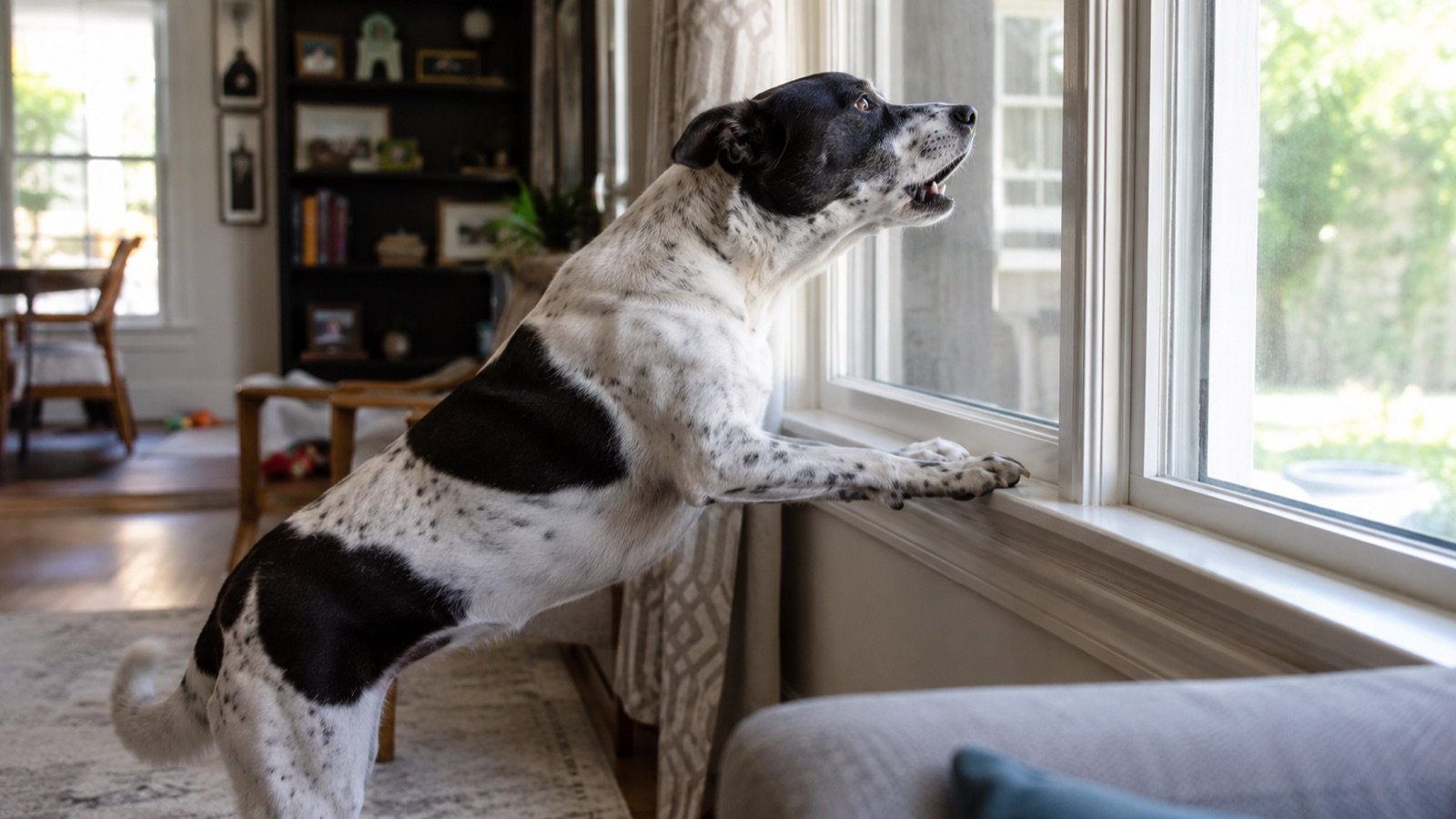
To stop a dog barking at everything, first find the reason — boredom, alarm, fear, or attention — because each needs a different fix. Then reward quiet, manage or block the trigger, and give your dog a daily outlet for energy. Never punish barking; it usually makes fearful barking worse.
One of my fosters, a little beagle mix, barked at the mail carrier, the neighbor's cat, the vacuum, and — I swear — clouds. It felt random. It wasn't. Once I sorted his barking into types, each one had a clear, force-free fix. Here's the same system, so you can bring the quiet back too.
Why does my dog bark at everything?
Barking isn't one behavior — it's several, each with its own cause. "Barking at everything" usually turns out to be a mix of these:
- Alarm / territorial: reacting to sights and sounds — the door, the window, passersby.
- Boredom: an under-exercised, under-stimulated dog barks to pass the time.
- Attention-seeking: barking that has been accidentally rewarded with your attention.
- Fear or anxiety: barking to create distance from something scary.
- Excitement / greeting: the happy, bouncy bark when you come home or a friend arrives.
- Frustration: barking at what your dog wants but can't reach.
The fix always starts the same way: figure out which type you're dealing with, because the wrong fix can make things worse.
Dogs can hear faint, distant sounds roughly four times farther away than we can — so "barking at nothing" is very often barking at something real you simply haven't noticed.
Source: general canine hearing research (veterinary references)Should you ever punish a dog for barking?
No. Yelling "quiet!", shaking a can, or using a shock or citronella collar might pause the noise, but it doesn't touch the cause — and it can make a fearful or reactive dog worse. A well-known University of Pennsylvania study (Herron, Shofer & Reisner, 2009) found that confrontational methods like hitting, yelling, or intimidating a dog frequently triggered an aggressive response, while reward-based methods rarely did.
Punishment also risks teaching your dog that the doorbell (or the other dog, or the visitor) predicts something bad — which can turn simple alarm barking into real fear. Reward the quiet instead. That's the thread through every fix below.
How do you stop attention-seeking barking?
This is the bark that says "look at me!" — and if looking at your dog (even to say "no") makes it stop, you've just paid for the bark. The fix feels counterintuitive:
- The instant the attention-barking starts, become boring — no eye contact, no talking, no touching. Turn away.
- The moment your dog pauses, even for a second, mark ("Yes!") and reward the quiet.
- Repeat. Your dog learns that quiet earns attention and barking makes you disappear.
Be ready for it to get briefly louder before it gets better — that's normal, and it fades if you stay consistent. If your dog barks at you for engagement, it's often a focus and motivation gap; my guide on why your dog ignores you tackles the same root.
How do you stop boredom barking?
A dog with nothing to do will make its own entertainment, and barking is a favorite. This is the easiest type to fix because the cure is enrichment, not correction. Add a real physical outlet plus daily brain work, and boredom barking often halves on its own.
Sniffing games, puzzle feeders, and short training sessions tire a dog out faster than a walk. I keep a full list in 12 mental stimulation games that actually tire dogs out — start there before you try to train the barking itself.
Brain Training for Dogs turns energy-burning enrichment into 21 structured games — the single most effective thing I've used to quiet a bored, barky dog. See what's inside in our honest review.
Read our Brain Training for Dogs review → Independent review · we may earn a commission at no extra cost to you.How do you stop alarm barking at the window and door?
Alarm barking is self-rewarding: your dog barks, the "intruder" (mail carrier, jogger) leaves, and your dog concludes the barking worked. Two moves break the cycle:
- Manage the environment. Close blinds, apply frosted window film, or move the dog bed away from the front window so there's less to react to. For the doorbell, desensitize by ringing it softly and rewarding calm.
- Answer the alarm calmly. When your dog alerts, acknowledge it — walk over, glance out, say a calm "thank you" — then redirect to a mat and reward. You're telling your dog, "I've got it, you can stand down."
How do you teach the "quiet" cue?
Once the environment is managed, teach an actual off-switch:
- Let your dog bark two or three times, then say "Quiet" once, in a calm voice.
- Hold a treat near their nose. Most dogs stop barking to sniff — they can't sniff and bark at once.
- The moment they're quiet, mark ("Yes!") and reward.
- Slowly stretch the quiet — two seconds, then five, then ten — before you pay.
Practice when it's easy (low distraction) before you expect it during a real doorbell. Building this cue is just like any other skill in my step-by-step home training guide.
Golden rule: reward the silence, not the bark. Every time you pay attention after the quiet — not during the noise — you teach your dog that calm is what works.
When should barking worry you?
Most barking is normal communication. But see your veterinarian if barking changes suddenly, if an older dog starts barking at walls or into empty rooms (a possible sign of canine cognitive decline), or if it comes with pacing, hiding, or other signs of pain or distress. Sudden new barking can have a medical cause worth ruling out.
Frequently asked questions
Why does my dog bark at people passing by the window?
That's territorial or alarm barking. Your dog sees movement, warns it off, and the person walks away — which your dog reads as the barking working. Block the view with film or furniture and reward calm, and the habit fades.
How do I stop my dog barking at other dogs on walks?
Add distance so your dog can see the other dog without reacting, then feed treats while the other dog is in view. Over many sessions your dog learns that other dogs predict good things, and the barking calms down.
Do anti-bark or shock collars work?
They may suppress the sound short-term but don't fix the cause, and they can increase fear and aggression. Veterinary behavior groups advise against them. Address the underlying reason instead.
Why does my dog bark for no reason?
There's always a reason — you just may not see it. Dogs hear far fainter, more distant sounds than we do, so "barking at nothing" is often barking at something real you can't detect.
What is the 3-bark rule?
It's a simple compromise: you let your dog alert-bark two or three times to say "I noticed something," then calmly cue "quiet" and reward the silence. It respects your dog's instinct to warn you without letting the barking run on and on.
Can a dog be trained not to bark at all?
You can dramatically reduce nuisance barking, but you can't — and shouldn't — stop a dog barking entirely, since it's normal communication. The goal is a reliable "quiet" cue and removing the triggers, so your dog barks appropriately instead of constantly.
Sources
Where this guide makes a claim about training method, behaviour or health, this is where it comes from. Checked August 2026.
- ASPCA. Barking — causes of different types of barking and how each is addressed. Accessed August 2026. aspca.org
- American Veterinary Society of Animal Behavior (AVSAB). Humane Dog Training Position Statement, 2021 — recommends that only reward-based training methods are used for all dog training, including the treatment of behaviour problems. Accessed August 2026. avsab.org
- Merck Veterinary Manual. Behavioral Problems of Dogs — clinical reference on canine behaviour problems and their management. Accessed August 2026. merckvetmanual.com

Canine behavior writer & rescue foster
Megan has fostered more than 30 rescue dogs, many of them barkers, and has quieted every one with force-free management and reward-based training — never a shock collar. She writes PawHonest to share the honest, hype-free advice she wishes she'd had with her first foster.
A note on trust: Sudden changes in barking — especially in older dogs, or with signs of pain, fear, or confusion — deserve a veterinary check. PawHonest is reader-supported: we may earn a small commission on purchases through our links, at no extra cost to you, and only recommend what we'd use on our own dogs.