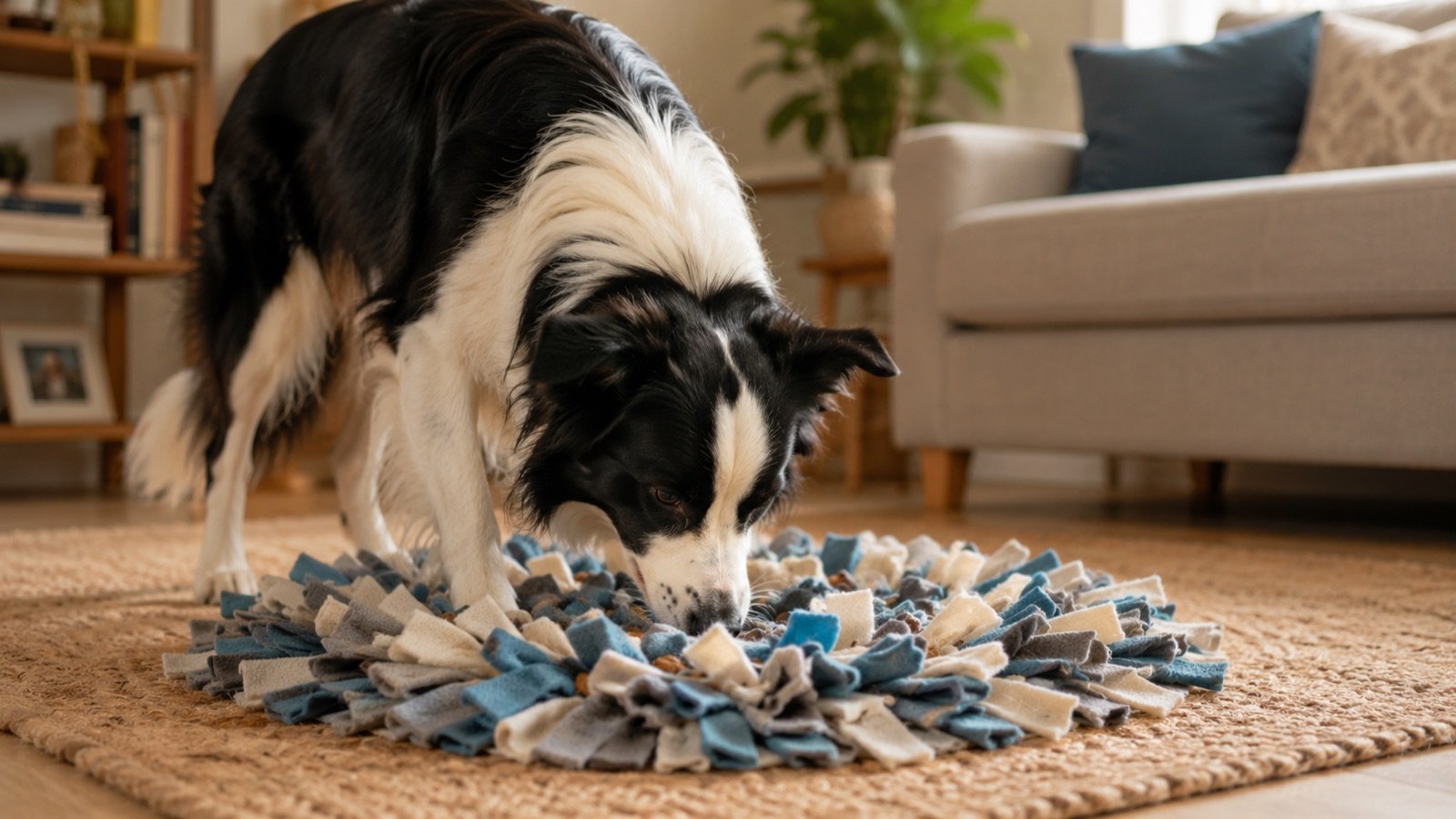
Mental stimulation for dogs means giving the brain a job: sniffing games, puzzle feeders, training and problem-solving toys. Fifteen to thirty minutes a day, split into short sessions, settles most dogs. It doesn't replace their walk — but a dog whose brain has worked barks, chews and paces far less.
Every foster dog I've taken in arrived with the same "problem": too much energy and nothing to do with it. And every time, the fix wasn't more walks — it was more thinking.
Below are 15 games, sorted from the ones any dog can do on day one to the ones that take real problem-solving. For each one I've put how long it usually holds a dog and the mistake that makes it fall flat, because a game that ends in ten seconds isn't stimulation — it's a snack.
Why does mental stimulation tire a dog out so fast?
Dogs were bred to work — sniffing, herding, retrieving, problem-solving. A modern pet dog often gets none of that, so all that mental horsepower has nowhere to go. It comes out as barking, chewing, and general chaos.
When you give a dog a puzzle to solve, you engage the same problem-solving circuits their working ancestors used all day. It's satisfying for them, and it drains energy in a way that a lap of the same park does not.
The average dog can learn to understand around 165 words and signals — a brain built for learning that craves a daily workout.
Source: Dr. Stanley Coren, The Intelligence of DogsIs 10 minutes of sniffing really equal to an hour of walking?
You've probably seen that line. It's on enrichment product pages, dog trainer reels, and half the snuffle mats for sale. Sometimes it's 10 minutes, sometimes 15, sometimes 20.
There's no study behind it. I went looking for the source and there isn't one — it appears to be a social-media paraphrase that hardened into a fact through repetition. Nobody has put dogs through an hour of walking and ten minutes of sniffing and measured the two against each other.
That matters here because this site is called PawHonest, and because the real research is more useful than the myth anyway.
What we do have is a small, well-designed study from Barnard College. Duranton and Horowitz split 20 pet dogs into two groups for two weeks: one group did daily nosework — searching for hidden food — and the other did heelwork, the classic walk-nicely-beside-me obedience exercise. Afterwards, the dogs were tested on how quickly they approached an ambiguous food bowl, a standard way of measuring whether an animal is expecting good things or bad ones.
The nosework dogs approached faster than they had before. The heelwork dogs didn't change. Two weeks of sniffing games had made the dogs measurably more optimistic. Two weeks of obedience drilling had not.
The honest caveat: that's 20 dogs, so treat it as a promising signal rather than settled fact. A 2025 review in the same journal went through 27 studies on scent activities and concluded there is still a notable research gap on how these tasks affect dogs' behaviour, physiology and welfare. The science is pointing in a good direction; it hasn't finished arriving.
So the accurate version of the claim is this: sniffing games appear to change how a dog feels, not just how tired they are. That's a better reason to do them than a made-up conversion rate — and it's why sniffing games sit at level 1 below, not as a beginner's consolation prize but as the thing most dogs need most.
What are the best mental stimulation games for dogs?
Here are 15, in three levels. Start one level below where you think your dog is. The fastest way to make brain games fail is to open with something too hard.
Level 1 — nothing to solve (start here)
No mechanism, no lid, no trick. The dog uses its nose and wins. Every dog can do these on day one, including puppies, seniors and dogs that have never played a game in their life.
- Scatter feed. Tip a handful of your dog's dinner into grass, a doormat or a snuffle mat and walk away.
Holds a dog: 5–10 minutes. Common mistake: doing it on a smooth floor, where the food is visible and gone in seconds. - "Find it." Toss one treat where your dog can see it land and say "find it." Once they get the pattern, throw it into longer grass, then hide it while they wait in another room.
Holds a dog: 3–5 minutes. Common mistake: hiding it too well too soon and letting them give up. - The towel roll. Lay a hand towel flat, scatter treats along it, roll it loosely, hand it over.
Holds a dog: 2–5 minutes. Common mistake: rolling it tight. Loose first, tighter over weeks. - Stuffed KONG or filled chew. Pack it with wet food or soaked kibble. Freeze it once your dog empties an unfrozen one easily.
Holds a dog: 10–30 minutes frozen. Common mistake: starting frozen and rock-solid, so the dog never gets a payout. - The sniffari walk. Same street, different rules: long line, loose leash, and the nose picks the route for twenty minutes. You follow.
Holds a dog: the whole walk. Common mistake: treating it as a normal walk with pauses. This one has no distance target at all.
Level 2 — one step of problem-solving
Now the food is behind something. The dog has to do one thing — move it, dig it out, choose — before the nose pays off.
- The muffin-tin game. Treats in some cups of a muffin tin, tennis balls over the top. Start with two balls and six open cups.
Holds a dog: 5–10 minutes. Common mistake: covering every cup on the first go. - Box search. A cardboard box, scrunched paper, treats buried in it. Cheap, endlessly renewable, and the shredding is part of the fun.
Holds a dog: 5–15 minutes. Common mistake: leaving the room — most dogs will eat cardboard given the chance. - The shell game. Treat under one of three cups, shuffle slowly, let them choose. Dogs track this by smell more than sight, which is why they're better at it than we expect.
Holds a dog: 3–5 minutes. Common mistake: shuffling fast to make it "fair." It isn't a magic trick. - Name the toys. Pick one toy, say its name every single time it appears for a week, then ask for it with a second toy present.
Holds a dog: 5 minutes a session, weeks of progress. Common mistake: introducing the second toy before the first name is solid. - Tug with rules. Tug, ask for a "drop," ask for a "sit," restart. The stopping is the training; the tugging is the wage.
Holds a dog: 5–10 minutes. Common mistake: only ever stopping to end the game, which teaches the dog that letting go is a punishment.
Level 3 — real thinking
Two or more steps, or a skill that has to be built rather than found. This is where a bored, clever dog finally gets interested — and where most owners run out of ideas.
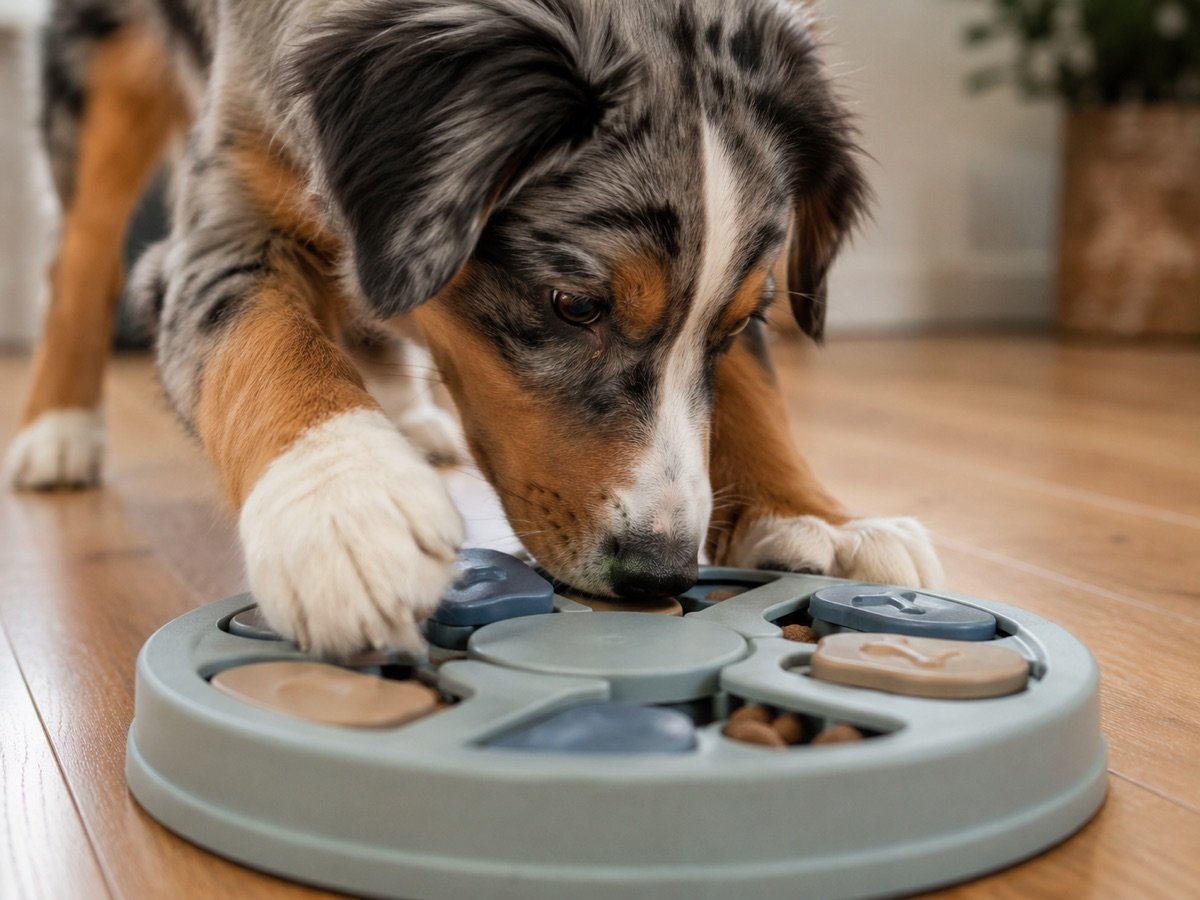
- Puzzle feeders with sliders and levers. The plastic boards with lids to push and drawers to pull. Begin with every lid half open, then close them one at a time over a fortnight.
Holds a dog: 5–20 minutes. Common mistake: buying an "advanced" board first. A puzzle that never pays out teaches a dog to stop trying. - Hide and seek — with you. Ask for a sit-stay, hide somewhere in the house, call once, stay quiet after that. Let them work it out.
Holds a dog: 10 minutes, and it doubles as recall practice. See teaching a reliable recall for the full method. - Learn a new trick. Spin, bow, "touch," crossed paws, put a toy in a box. Anything new is prime brain work — the novelty is the point, not the trick.
Holds a dog: 5–10 minutes a session. Common mistake: long sessions. Two short ones beat one long one every time. - Shaping with a box. Put an empty box on the floor and mark and reward anything your dog does towards it — a glance, a step, a nose touch, a paw in. You say nothing and give no cues. It's the hardest game on this list for the human.
Holds a dog: 3–5 minutes, and most dogs are genuinely tired afterwards. Common mistake: helping. The whole value is in the dog making its own choices. - A home-made scent trail. Rub a treat along the floor into another room and hide it at the end. Later, use a scented tin your dog has to find and indicate. This is the entry point to proper nosework — the same activity as the study above.
Holds a dog: 10–20 minutes. Common mistake: laying the trail while the dog watches.
Which game should I pick right now?
The best game is the one you'll actually run today. Find your situation:
| Your situation | The game | Holds a dog for |
|---|---|---|
| Two minutes, no equipment, dog already wound up | Scatter feed in grass or on a doormat | 5–10 min |
| You're about to leave the house | Frozen stuffed KONG, handed over as you go | 10–30 min |
| Raining, and the walk is cancelled | Box search, then a towel roll | 15–20 min |
| Evening zoomies, every night, same time | Scatter feed 30 minutes before they normally start | Prevents the whole episode |
| Clever dog, bored of everything | Shaping with a box or a scent trail | 3–20 min |
| Puppy under 4 months | Snuffle mat or "find it", 2–5 min only | 2–5 min |
| Senior dog, stiff, sleeps most of the day | Snuffle mat at floor height, sitting down | 5 min |
The hard part isn't finding a game — it's knowing what comes next when your dog masters one. Brain Training for Dogs is built as a ladder: 21 games arranged in escalating levels, so you always have the next challenge ready. It's the program we recommend for exactly this problem.
Read our honest review → Independent review · we may earn a commission at no extra cost to you.How do you make a game harder without your dog giving up?
This is the part almost nobody covers, and it's the reason expensive puzzle toys end up in a cupboard.
A dog that fails repeatedly doesn't try harder. It stops playing — and worse, it learns that this type of object is not worth investigating. I've fostered dogs who wouldn't touch a puzzle feeder because someone had already taught them it was pointless.
The rule I use: keep them winning about four times out of five. If your dog solves it every single time with no pause, it's too easy and nothing is being worked. If they're failing more than one go in five, back off a level.
Making something harder means changing one thing:
- Close one more lid. Not all of them.
- Roll the towel one turn tighter.
- Hide the treat one room further away.
- Add one more distraction — a person in the room, a TV on.
- Wait three seconds longer before releasing them to start.
And watch what your dog does about a minute into failing. Barking at the toy, hard pawing, walking off, or lying down beside it are all the same message: this is above me. Make it easier, let them win twice, then stop for the day.
Which brain games build impulse control?
Impulse control is the ability to not do the first thing that comes to mind. It's the skill underneath door manners, recall, polite greetings, and leaving the sandwich on the coffee table alone. It's also the thing owners actually want when they say they want a "calmer" dog.
You don't need a separate plan for it. You build it inside the games above, by adding a pause:
- Before the scatter feed. Hold the food, ask for a sit, wait two seconds, then release. Build to five seconds, then ten.
- Between tug rounds. "Drop," then a sit, then restart. The restart is the reward for letting go.
- During "find it." Ask your dog to stay while you place the treat in plain sight, then release them to it.
- At the puzzle feeder. Put it down, keep a hand on it, release when they stop shoving.
That's the direct route. There's an indirect one too, and it surprised me.
A 2024 study at Aberystwyth University compared pet dogs whose main hobby was scent work, agility, or obedience. Every dog did two standard impulse-control tasks: one where the dog has to drop a habit it just learned, and one where it has to walk away from visible food to get around a barrier.
The scent work dogs showed more inhibitory control and more persistence across both tasks — not better raw scores, but more self-control and less giving up. Nobody had drilled self-control at them. They'd just been sniffing.
What to take from that. The level 1 sniffing games aren't the beginner tier you graduate out of. Alongside the Barnard nosework result above, they look like the games that change a dog most — and they're the easiest ones to run on a bad evening.
Impulse control is also where a structured program earns its keep, because the difficulty has to rise in the right order — which is exactly the four-out-of-five problem above. Random games plateau. If you'd rather follow a ladder than invent one, our honest review of Brain Training for Dogs covers how its 21 games escalate, and who it isn't worth the money for.
What mental stimulation games are best for puppies?
Puppies need brain work more than adult dogs do — but in much smaller doses. A young puppy's attention burns out after a couple of minutes, and a game that goes on too long stops being fun and starts being frustrating.
So the rule I use with every foster puppy: two to five minutes, two or three times a day. Stop while they still want more. That's it.
From the list above, level 1 is the whole puppy curriculum — scatter feeding, "find it," the towel roll, a softly stuffed KONG. Add naming one toy, because puppies learn names remarkably fast and it's the foundation of everything later.
The ones to hold back on for now:
- Hard plastic puzzle feeders with sliding lids. Most puppies can't solve them yet, and a puzzle that never pays out teaches them to give up.
- The shell game and the muffin tin. Save these for four months and up — they need more patience than a young puppy has.
- Long tug sessions. Short and gentle is fine, but go easy: teeth are still coming in and joints are still growing.
- Shaping with a box. Genuinely hard, and a young puppy will get frustrated before the first breakthrough.
Two safety notes. Cardboard and paper games are excellent for puppies, but stay in the room — puppies swallow what they shred. And ask your vet before giving hard chews to a teething puppy.
Why this matters more than it sounds
Most of what new owners call "bad puppy behaviour" — the shark-teeth biting, the 8pm zoomies, the chewing the sofa leg — is an under-worked brain with nowhere to put itself. Five minutes of sniffing before the witching hour prevents more trouble than any correction does.
Brain games also build impulse control, which is the skill underneath everything else. Asking a puppy to wait a beat before you release the snuffle mat, or to sit before the tug restarts, is impulse control training disguised as play. That's the same muscle they'll use later to not bolt out of an open door.
If your puppy has just arrived, start with the first day at home and add these games from day two or three.
Are brain games worth it for a senior dog?
This is the age group with the strongest evidence behind it, and it's the one owners most often write off.
Researchers at the University of Toronto followed aged beagles for two years, splitting them into groups that differed in diet and in whether they got a programme of behavioural enrichment — more exercise, a richer environment, and regular cognitive work. Published in Neurobiology of Aging, the result was clear: discrimination learning was significantly improved by behavioural enrichment, and the dogs getting both enrichment and a fortified diet learned more accurately than every other aged group.
In plain terms: an old dog that keeps being asked to think holds on to its ability to learn for longer than one left to sleep through the day. "Too old to bother" is the wrong conclusion.
What changes with an older dog is the format, not the frequency:
- Stay at level 1 and 2. Sniffing, not solving. A snuffle mat placed at floor height beats any plastic board.
- No jumping, no twisting, no hard flooring. Put a rug down and let them work lying down if they want to.
- Shorter, more often. Five minutes, three times a day.
- Easier than you think. Failing is more discouraging at twelve than at two.
One caveat worth stating plainly: new restlessness, pacing or night-time disturbance in an older dog is not automatically boredom. It can be pain, cognitive dysfunction or a medical problem — see senior dog panting at night and talk to your vet before you assume it's an under-worked brain. There's also more on adapting sessions in training an older dog.
If your senior is stiff getting up rather than uninterested in playing, that's a body problem and not a stimulation one — so a vet check comes first. Once pain has been ruled out, UltraK9 Pro is the daily liquid we point older-dog owners to: turmeric for the inflammation side, collagen for the structural side, poured straight onto food. From $39 a bottle with a 60-day money-back guarantee.
Read our honest UltraK9 Pro review → Independent review · we may earn a commission at no extra cost to you.What about a dog that can't be exercised much?
Everything above assumes you could walk the dog further if you wanted to. For a lot of readers, that isn't true — and this is where brain games stop being a nice extra and become the main event.
Flat-faced breeds. Pugs, French bulldogs, boxers and shih tzus often can't be tired out physically at all. Heat and a shortened airway put a hard ceiling on exercise long before the dog's energy runs out, and pushing past it is genuinely dangerous rather than just uncomfortable. For these dogs, enrichment isn't a supplement to the walk — it's the substitute. Before deciding how much exercise is realistic, read what the research found on French bulldog health problems and pug health issues: in one German study, 49% of French bulldogs didn't tolerate heat, and most owners of affected dogs had never had the breathing formally assessed.
Dogs on crate rest. After surgery or an injury, anything the dog can do lying down works: a frozen KONG, a licking mat, a towel roll, naming toys from a down position. This is often the difference between a bearable recovery and a miserable one — and a bored dog on crate rest is a dog that re-injures itself.
Working breeds in small homes. The border collie in a flat is the classic case of a dog that gets plenty of walking and is still climbing the walls. More distance won't fix it. A daily job will.
One honest limit, though. A 2026 pilot study compared 26 dogs, some doing nose work training and some not. The nose work dogs scored higher on a dog executive function scale, and the ones with formal training titles gave up least on an unsolvable task — but their physical fitness scores were no different. Brain games settle a dog's mind and build its self-control. They do not condition its body. If your dog can safely move, it still needs to.
How does mental stimulation make training easier?
A dog that gets to think every day comes to training sessions calmer and more focused. Brain games also teach the exact skill training depends on: paying attention and working with you to earn a reward. That's why I treat mental games as step one for any new foster — before I ask for a single "sit." For the full sequence, see my guide on how to train your dog at home.
It runs the other way too. The behaviours people most want to stop are often the ones an under-worked brain invents: chewing everything in reach, and barking at every sound. Adding a daily game is usually cheaper and faster than trying to suppress the symptom.
Boredom check: chewing, barking, digging, pacing, and pestering you are almost always signs of an under-stimulated brain — not a "bad dog." Add a daily game before you reach for a correction. But if these appear suddenly in a dog that never did them, rule out pain or illness with your vet first.
Why do brain games sometimes stop working?
Five mistakes account for nearly all of it. I've made every one of them.
- The toys live on the floor. Novelty is half the value. Keep three or four away in a cupboard and rotate weekly — the same puzzle feels new again after a fortnight out of sight.
- Everything is food. A dog that only ever works for kibble gets bored of working when it isn't hungry. Mix in tug, trick training and toy-naming, which pay in play and attention instead.
- The game starts too late. Handing a snuffle mat to a dog that's already spinning in circles rarely lands. Run the game before the daily meltdown, not during it — 30 minutes before the usual zoomie hour.
- It's used as a babysitter for anxiety. A frozen KONG does not treat separation anxiety. A genuinely panicking dog won't touch it, and a dog that only eats it while you're still home has learned nothing about being alone. Enrichment supports a graduated absence plan; it doesn't replace one.
- The level never moves. The same puzzle at the same difficulty for six months stops being a puzzle. Use the four-out-of-five rule above and nudge it up.
- The puzzle is competing with a full bowl. If there's easy food available, that's where your dog is going first. Puzzle feeding only works when the puzzle is the meal — see below.
"My dog goes to the bowl and ignores the puzzle"
This one deserves its own answer, because owners read it as failure and it isn't.
In a 2024 study, 38 pet dogs were offered a snuffle mat and an open tray holding the same food, side by side, ten times each. If dogs really "love to work for their food," they should pick the mat.
Only about a quarter of the dogs' first choices went to the snuffle mat — most went straight to the free tray. But all 38 dogs still worked the mat while free food was sitting right there.
Source: Rothkoff, Feng & Byosiere (2024), Scientific ReportsThe authors' phrasing is the useful bit: dogs show a willingness to work for food, but not a preference for it.
So your dog isn't rejecting enrichment. It's doing what almost every dog does — taking the easy calories first, then going back to the interesting thing. The fix is simply to stop offering both: make the puzzle the meal, not a rival to one.
How much mental stimulation does a dog actually need?
Most dogs thrive on 15 to 30 minutes of active brain work a day, split into short bursts. Working breeds like border collies and shepherds need more; senior dogs need gentler puzzles more often. Puppies need far less in one go — two to five minutes at a time, a few times a day, is plenty.
And to be clear about the thing the internet keeps blurring: this is in addition to walks, not instead of them. Brain games settle the mind. They don't move joints, build muscle, manage weight or get a dog outside to toilet. A dog needs both.
If you'd rather start from a plan than from a number, this is roughly how I run a foster dog's first week. Nothing on it takes more than fifteen minutes, and the variety is deliberate — novelty is doing half the work.
| Day | Morning (5 min) | Evening (10–15 min) |
|---|---|---|
| Mon | Scatter feed breakfast in grass | Puzzle feeder for dinner, easiest setting |
| Tue | Snuffle mat | Sniffari walk — nose picks the route |
| Wed | "Find it" × 10 | Muffin-tin game, two balls only |
| Thu | Scatter feed breakfast | Trick training, then tug with rules |
| Fri | Box search | Frozen KONG |
| Sat | Towel roll | Sniffari on a street you've never walked |
| Sun | Name the toys | Rest — a day off is fine, and useful |
Run that for a fortnight before you judge whether it's working. One good evening proves nothing either way.
The honest measure is your own dog. If the barking, the chewing and the pacing fade over a fortnight, you've found the right amount. If nothing shifts at all, the games are probably too easy — or the problem was never boredom.
Frequently asked questions
How much mental stimulation does a dog need per day?
Most dogs do well with 15 to 30 minutes of active brain work a day, split into short bursts rather than one long session. High-energy and working breeds often need more. The honest test is your own dog: if the barking, chewing and pacing fade, you've found the right amount.
Is 10 minutes of sniffing really equal to an hour of walking?
No study supports that number. It spread through social media and enrichment marketing, not through research. A 2025 scoping review in Applied Animal Behaviour Science went through 27 studies on scent activities and found a notable research gap on exactly this kind of question. Sniffing is genuinely valuable — but nobody has measured it against walking minute for minute.
Can mental stimulation replace walks for a dog?
No. Brain games settle the mind, but dogs still need physical movement for joints, muscle, weight and toileting. Use brain games to take the edge off a hyper dog and to fill days when a long walk isn't possible — not as a permanent substitute for one.
What are the signs my dog is bored?
Chewing furniture, excessive barking, digging, pacing, restlessness, and attention-seeking are all classic boredom signals. They usually shrink once a dog gets a daily outlet for its brain. If they appear suddenly in a dog that never did them, rule out pain or illness with your vet first.
Can you give a dog mental stimulation without food or treats?
Yes. Plenty of brain work uses no food: teaching a new trick, name-the-toy games, tug with rules, letting your dog sniff freely on a "sniffari" walk, or hide-and-seek with you. Food puzzles are great, but variety and novelty are what tire the brain.
How do I know if a puzzle is too hard for my dog?
Watch what your dog does about a minute into failing. Barking at the toy, hard pawing, walking away, or lying down next to it all mean the puzzle is above their level. Make it easier until they win roughly four attempts out of five, then raise it again.
Why does my dog go to the food bowl before the puzzle feeder?
Because that's what most dogs do. In a 2024 study of 38 pet dogs given a snuffle mat and a free tray of food side by side, only about a quarter of first choices went to the snuffle mat. Every single dog still worked the mat while free food was sitting there. Going to the easy food first is normal — it just means the puzzle needs to be the meal, not a competitor to one.
Which brain games build impulse control?
Any game where your dog has to wait before it's released: a pause before you hand over the snuffle mat, a sit before the tug restarts, or holding position while a treat is placed on the floor. Scent games build the same skill sideways — in a 2024 study, dogs trained in scent work showed more inhibitory control and persistence than dogs trained in agility or obedience.
What can I do for a dog that can't be exercised much?
Brain games are the answer for flat-faced breeds, dogs on crate rest, and seniors with sore joints, because they give a real outlet without stressing the body. Be clear about the limit, though: a 2026 study found nose work training was linked to better executive function in dogs but made no difference to their physical fitness scores. Games settle the mind; they don't condition the body. Ask your vet how much movement is safe and use enrichment to fill the rest.
What are the best mental stimulation games for puppies?
Stick to games with no puzzle to solve: a snuffle mat or scattered kibble, "find it" with a single tossed treat, a loosely rolled towel, naming one toy, or a softly stuffed KONG. Keep sessions to two to five minutes, a few times a day, and stop while your puppy still wants more.
How much mental stimulation does a puppy need a day?
Far less per session than an adult dog. Two to five minutes at a time, two or three times a day, is plenty for a young puppy — their attention burns out fast, and a game that runs too long turns into frustration. Little and often beats one long session.
What games tire a puppy out?
Sniffing games tire a puppy faster than running does. Scatter their kibble in the grass or in a snuffle mat and let them work for it. Five minutes of that before the evening "zoomies" prevents more chaos than any amount of physical play.
Are brain games good for senior dogs?
Yes — and this is the age group with the strongest evidence behind it. In a two-year study of aged beagles published in Neurobiology of Aging, behavioural enrichment significantly improved learning compared with dogs kept on a normal routine. Keep the puzzles easy, the sessions short, and the games low-impact on the joints.
Do brain games fix separation anxiety?
Not on their own. A dog panicking about being alone will usually ignore a stuffed KONG entirely, and a dog that only eats it while you're still home hasn't learned anything about being alone. Separation anxiety needs a graduated absence plan; enrichment supports that plan but doesn't replace it.
How do you keep a dog mentally stimulated while you're at work?
Leave a stuffed frozen KONG, a snuffle mat, or food-dispensing puzzle toys, and rotate them so they stay novel. A safe chew or a puzzle feeder for meals gives your dog a job to do. Tiring their brain with a game before you leave helps too.
Sources
Where this guide makes a claim about training method, behaviour or health, this is where it comes from. Checked September 2026.
- Duranton, C. & Horowitz, A. (2019). "Let me sniff! Nosework induces positive judgment bias in pet dogs." Applied Animal Behaviour Science, 211, 61–66 — 20 pet dogs; two weeks of nosework reduced latency to approach an ambiguous stimulus, a marker of optimism, while two weeks of heelwork did not. Accessed September 2026. doi.org
- Fountain, J., Fernández, E. J., McWhorter, T. J. & Hazel, S. J. (2025). "The value of sniffing: A scoping review of scent activities for canines." Applied Animal Behaviour Science, 282, 106485 — 27 studies reviewed under PRISMA; the authors report a notable research gap on how scent tasks affect dogs' behaviour, physiology and welfare. Accessed September 2026. doi.org
- Milgram, N. W., Head, E., Zicker, S. C., et al. (2005). "Learning ability in aged beagle dogs is preserved by behavioral enrichment and dietary fortification: a two-year longitudinal study." Neurobiology of Aging, 26(1), 77–90 — discrimination learning was significantly improved by behavioural enrichment; combined enrichment and dietary fortification outperformed either alone. Accessed September 2026. pubmed.ncbi.nlm.nih.gov
- Mellor, N., McBride, S., Stoker, E. & Dalesman, S. (2024). "Impact of Training Discipline and Experience on Inhibitory Control and Cognitive Performance in Pet Dogs." Animals, 14(3), 428 — pet dogs trained in scent work "demonstrated higher levels of inhibitory control and persistence across the two tasks" compared with agility- and obedience-trained dogs. Accessed September 2026. doi.org
- Rothkoff, L., Feng, L. & Byosiere, S.-E. (2024). "Domestic pet dogs (Canis lupus familiaris) do not show a preference to contrafreeload, but are willing to work for food." Scientific Reports, 14 — 38 pet dogs offered a snuffle mat and a free tray over 10 trials; the mean proportion of first choices to the snuffle mat was 0.262, yet all 38 dogs interacted with the mat while free food was still available. Accessed September 2026. ncbi.nlm.nih.gov
- Kluess, H. A. & Neff, A. H. (2026). "Does Nose Work Training Affect Dog Executive Function and Physical Fitness in Humans and Dogs?" Animals, 16(3), 453 — 26 dogs; nose work training was associated with higher reported executive function scores and less giving up on an unsolvable task, while fitness scores did not differ between groups. Accessed September 2026. ncbi.nlm.nih.gov
- American Veterinary Society of Animal Behavior (AVSAB). Humane Dog Training Position Statement, 2021 — recommends that only reward-based training methods are used for all dog training, including the treatment of behaviour problems. Accessed September 2026. avsab.org
- Merck Veterinary Manual. Behavioral Problems of Dogs — clinical reference on canine behaviour problems and their management. Accessed September 2026. merckvetmanual.com
- ASPCA. Common Dog Behavior Issues — reference library on everyday dog behaviour. Accessed September 2026. aspca.org
Canine behavior writer & rescue foster
Megan has fostered more than 30 rescue dogs and swears mental games are the fastest way to calm a "crazy" dog. She writes PawHonest to share the honest, force-free advice she wishes she'd had at the start.
A note on trust: This article covers enrichment and everyday behavior. For sudden restlessness, compulsive behaviors, or any abrupt change, check with your veterinarian first. PawHonest is reader-supported: we may earn a small commission on purchases made through our links, at no extra cost to you, and only recommend what we'd use on our own dogs.