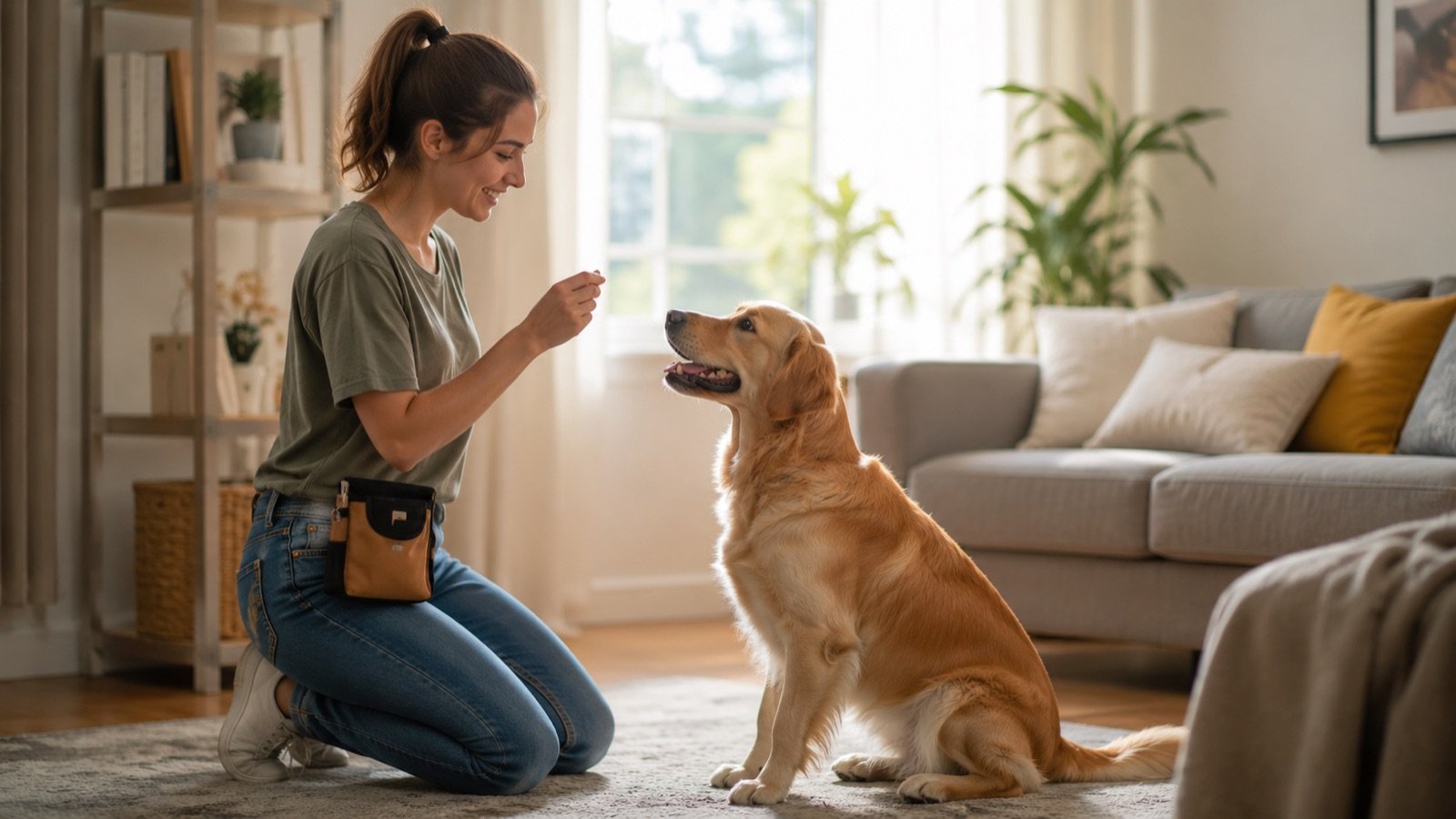
You can train your dog at home with short, positive sessions of 5–10 minutes, rewarding the behavior you want the instant it happens and raising the difficulty gradually. Work on one skill at a time, keep it playful, and practice daily — consistency matters far more than long lessons.
When I brought home my first foster dog, a wiry terrier mix who had never lived indoors, I thought I'd need to hire a professional. I didn't. Everything that dog learned — his name, sit, coming when called, walking without dragging me down the street — happened on my kitchen floor in ten-minute chunks.
That's the good news I want you to hold onto: the basics of dog training are simple, and you can absolutely do them at home. This guide walks you through exactly how, in the order that actually works.
Can you really train your dog at home without a professional?
Yes — for everyday manners, home training is not only possible, it's usually better. Your dog learns in the environment where they actually live, with the person they trust most. A trainer is worth it for serious issues like aggression or severe anxiety, but sit, stay, recall, and leash manners are well within your reach.
The science backs this up. The American Veterinary Society of Animal Behavior (AVSAB) recommends reward-based training — rewarding good behavior rather than punishing bad behavior — as the most effective and humane approach for pet dogs. In plain English: catch your dog doing something right and pay them for it.
The number of words, signals, and gestures the average dog can learn to understand — and "super dogs" in the top 20% can learn 250 or more.
Source: Dr. Stanley Coren, The Intelligence of DogsYour dog's brain is wired to learn from you. Training isn't about forcing obedience — it's about communication. Once you speak the same language, most "bad behavior" simply melts away.
What do you need before you start?
You don't need fancy gear. You need four things:
- High-value treats. Small, soft, and exciting — think tiny bits of chicken or cheese, not dry biscuits. Cut them pea-sized so your dog can eat fast and stay in the game.
- A marker word. Pick one short word — "Yes!" works great — that you say the exact moment your dog does the right thing. This tells them precisely which action earned the treat. A clicker does the same job.
- A quiet space. Start in a boring room with no distractions. You'll add distractions later, on purpose.
- Short sessions. Five to ten minutes, two or three times a day. Stop while your dog still wants more.
The timing rule that changes everything: your marker word and reward must come within about one second of the behavior. Wait too long and your dog thinks the treat was for whatever they did next — like standing up.
How do you build focus and a reliable "look at me"?
Before any command, your dog needs to pay attention to you. This is the skill everyone skips, and it's the one that makes everything else easy.
- Hold a treat by your dog's nose, then slowly bring it up to your eyes.
- The instant your dog's eyes follow to your face, say your marker word and give the treat.
- Repeat, then add the cue "Look" or "Watch me" right before you move the treat.
- Slowly ask for a little more eye contact — one second, then two, then three — before you pay.
Practice this for a few days and you'll have a dog who checks in with you automatically. That single habit is the foundation of walking nicely, coming when called, and ignoring distractions.
What order should you teach commands in?
Teach one skill at a time, and build them in this order — each one leans on the one before it:
- Their name. Say the name, and the moment your dog looks at you, mark and reward. Their name should always predict something good.
- Sit. Hold a treat above the nose and move it back over the head; as the nose goes up, the bottom goes down. Mark the sit, then reward.
- Come (recall). Back away happily, call your dog's name plus "Come," and throw a party when they reach you. Never call your dog to do something they dislike, or the word loses its magic.
- Stay. Ask for a sit, take one step back, return, and reward. Add distance and time slowly.
- Leash manners. Reward your dog for being near your side. When the leash goes tight, stop walking. Moving forward is the reward for a loose leash.
Struggling with a dog who tunes you out mid-lesson? That's usually a focus and motivation problem, not stubbornness. I break it down in Why Does My Dog Ignore Me? 7 Real Reasons (and Fixes).
If you'd rather follow a step-by-step program that games out every skill for you, Brain Training for Dogs is the force-free course I recommend to new fosters. We tested it in depth on PawHonest.
Read our full honest review → Independent review · we may earn a commission at no extra cost to you.How do you fix bad habits like barking, chewing, and pulling?
Here's the mindset shift: most "bad" behaviors are just normal dog behaviors pointed in the wrong direction. A dog barks, chews, digs, and pulls because those things feel good and pass the time. The fix is rarely punishment — it's redirecting the energy and rewarding the alternative.
- Barking: figure out the trigger (boredom, alert, attention) and address the cause, then teach and reward a "quiet" cue.
- Chewing: puppy-proof the room, provide legal chew toys, and praise your dog for choosing them.
- Pulling: stop moving when the leash tightens; reward every step of slack.
Notice the pattern — a bored dog is a destructive dog. Which brings us to the single most underrated training tool.
Why does mental stimulation make training easier?
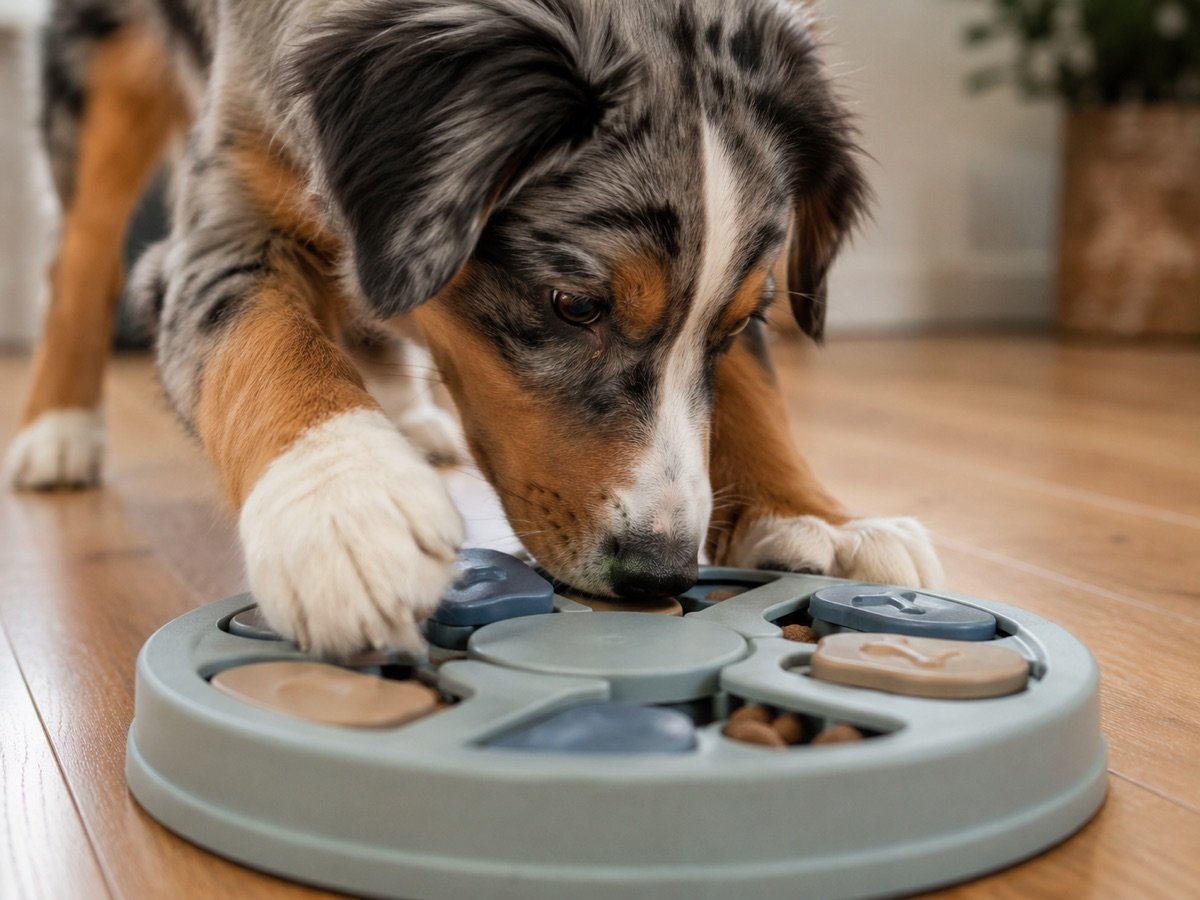
A dog that gets to think every day is calmer, more focused, and far easier to train. Sniffing games, puzzle feeders, and "find it" searches tire a dog out more than a walk does, because they work the brain — and a tired brain has no energy left for barking at the mailman.
This is exactly why brain-based programs work so well: they turn training into a puzzle your dog wants to solve. I put together 12 easy games you can start today in Mental Stimulation for Dogs: 15 Games That Actually Tire Them Out.
How long does it take to train a dog at home?
A dog can learn the shape of a new command in a single session, but making it reliable — in any room, around any distraction — takes weeks of short daily practice. Expect solid basics in 4 to 8 weeks if you train most days. Progress isn't a straight line; some days go backward, and that's completely normal.
The dogs that learn fastest aren't the "smart" breeds. They're the ones whose owners train a little every single day and keep it fun.
A few off days is normal. But if your dog is suddenly slower to sit, reluctant to hold a "stay," or stiff after a session, that can be joints rather than a training plateau — worth a vet check before you assume it's motivation. Once pain is ruled out, UltraK9 Pro is the daily liquid we point owners to: turmeric for the inflammation side, collagen for the structural side, poured straight onto food. From $39 a bottle with a 60-day money-back guarantee.
Read our honest UltraK9 Pro review → Independent review · we may earn a commission at no extra cost to you.Brain Training for Dogs turns everyday obedience into 21 games and puzzles your dog will beg to play — force-free, and built by a certified trainer. See exactly what's inside before you decide.
Check the program & today's price → Affiliate link · we may earn a commission at no extra cost to you.Frequently asked questions
How many minutes a day should I train my dog?
Aim for two or three short sessions of 5 to 10 minutes each. Dogs learn better in brief, frequent bursts than in one long lesson, and short sessions keep training fun instead of frustrating.
What is the best age to start training a dog?
You can start gentle, positive training the day your puppy comes home, usually around 8 weeks. But it's never too late — adult and senior dogs learn well too, they just need patience and consistency.
Do I have to use treats forever?
No. Treats are how you teach a new skill quickly, but once the behavior is reliable you fade them out and reward randomly with treats, praise, play, or life rewards like a walk or a game.
Why won't my dog listen to me outside the house?
Outdoors is full of smells and distractions, so a command your dog knows perfectly in the kitchen can fall apart in the yard. Practice each skill in gradually harder places and use higher-value treats when distractions increase.
Can I train an older dog at home?
Yes. The old saying is wrong — older dogs learn new skills readily and often focus better than puppies. Keep sessions short and gentle on the joints, and reward generously.
What is the 3-3-3 rule for dog training?
The 3-3-3 rule describes how a newly adopted dog settles in: about 3 days to decompress and feel overwhelmed, 3 weeks to start learning your routine, and 3 months to feel fully at home. Keep training low-pressure and gentle during those first weeks.
What are the 7 most important dog commands?
The core seven most owners teach are sit, come (recall), stay, down, leave it, heel or loose-leash walking, and off. Master those and you have a safe, well-mannered dog for everyday life.
What's the fastest way to train a dog?
Short, daily, reward-based sessions of 5–10 minutes, working on one skill at a time and rewarding the instant your dog gets it right. Consistency beats long, occasional sessions every time.
Sources
Where this guide makes a claim about training method, behaviour or health, this is where it comes from. Checked August 2026.
- American Veterinary Society of Animal Behavior (AVSAB). Humane Dog Training Position Statement, 2021 — recommends that only reward-based training methods are used for all dog training, including the treatment of behaviour problems. Accessed August 2026. avsab.org
- ASPCA. Common Dog Behavior Issues — reference library on everyday dog behaviour. Accessed August 2026. aspca.org
- Merck Veterinary Manual. Behavioral Problems of Dogs — clinical reference on canine behaviour problems and their management. Accessed August 2026. merckvetmanual.com
Canine behavior writer & rescue foster
Megan has fostered more than 30 rescue dogs, most of them anxious or under-socialized, and has trained every one of them at home using force-free methods. She writes PawHonest to give new dog owners the honest, hype-free guidance she wishes she'd had with her first foster.
A note on trust: This guide covers everyday obedience and manners. For aggression, severe anxiety, or any sudden behavior change, please consult your veterinarian or a certified behaviorist — those can have medical causes and deserve a professional. PawHonest is reader-supported: when you buy through links on this page we may earn a small commission, at no extra cost to you. We only recommend products we'd use on our own dogs.