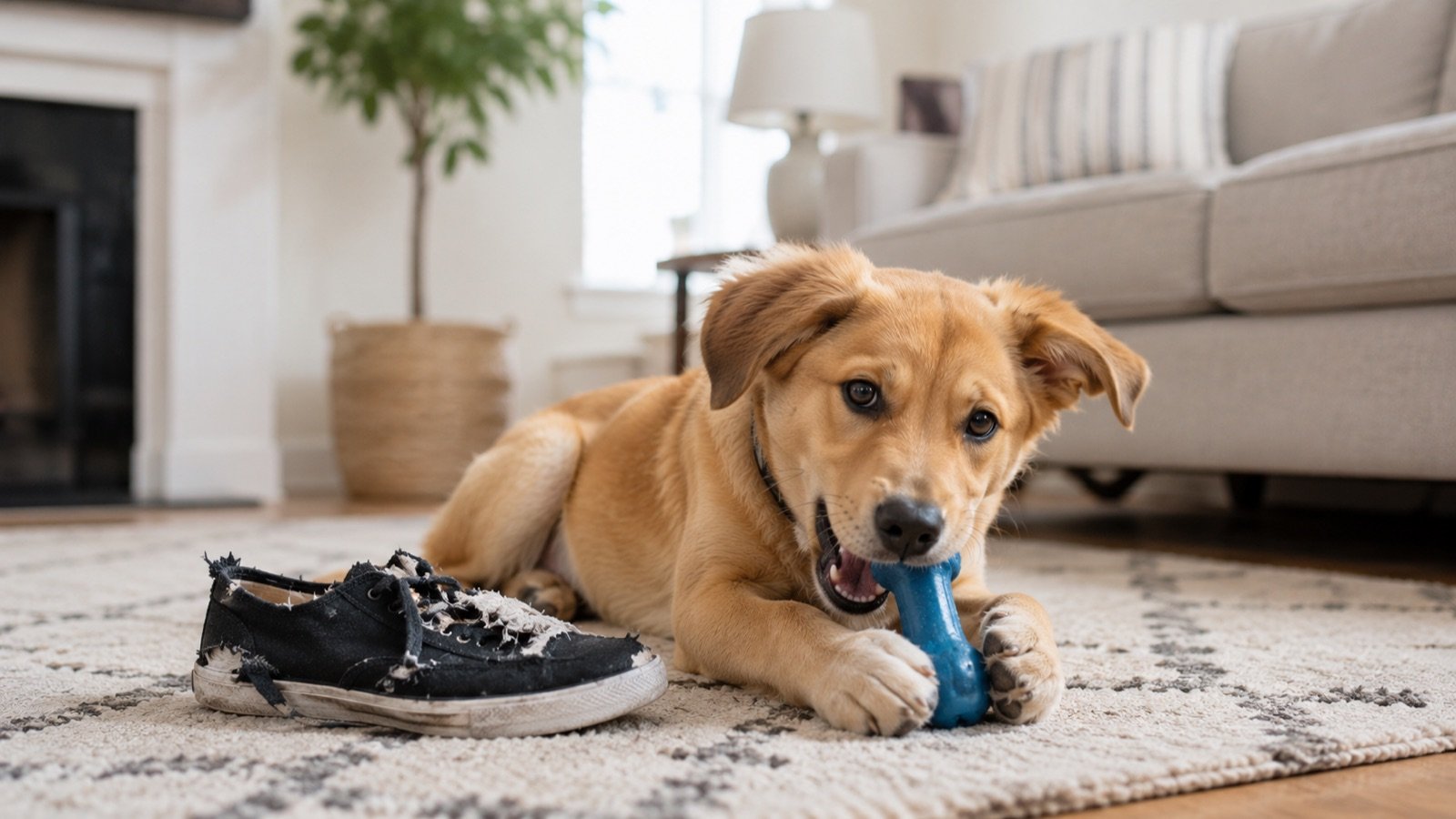
To stop a dog chewing everything, give the urge a legal outlet and manage the environment. Puppy-proof the room, provide appealing chew toys, and reward your dog for choosing them. Never punish after the fact — redirect in the moment. Most chewing is teething, boredom, or anxiety, and each has its own fix.
Chewed shoes, table legs, the corner of the couch — I've fostered dogs who treated my whole house like a chew toy. Here's the reframe that fixes it: chewing isn't "bad behavior," it's a normal, healthy dog need. Your job isn't to eliminate it, but to redirect it. Do that, and the destruction stops.
Why does my dog chew everything?
Chewing almost always traces back to one of these:
- Teething (puppies): sore gums feel better with something to gnaw.
- Boredom: an under-stimulated dog chews to pass the time.
- Stress or anxiety: chewing is soothing, so an anxious dog does more of it.
- Exploration & hunger: dogs investigate the world with their mouths, and an empty stomach makes everything more tempting.
- Attention-seeking: grabbing your slipper reliably gets a reaction.
Figure out which is driving it, because the fix follows the cause.
Most puppies finish teething by around six months of age, when the heaviest chewing usually eases. Until then, expect it — and redirect it rather than fight it.
Source: general veterinary/puppy development guidanceHow do you actually stop destructive chewing?
It comes down to a simple three-part plan:
- Manage the environment. Puppy-proof: pick up shoes, hide cords, and use gates or a playpen so your dog simply can't practice chewing the wrong things while learning.
- Provide better options. Offer a variety of safe, appealing chew toys so there's always a legal outlet nearby. Rotate them to keep them novel.
- Redirect and reward. Catch your dog chewing something off-limits? Calmly swap it for a chew toy, then praise and reward the moment they take it. You're teaching "chew this, not that" — the same interrupt-and-redirect skill behind a solid recall.
Never punish after the fact. If you scold your dog for a chewed item you find later, they can't connect the telling-off to the chewing — they just learn to fear you. Redirect in the moment, or manage so it can't happen.
What chew toys are best — and safest?
Give your dog things designed to be chewed, sized for their mouth:
- Durable rubber toys (like a KONG) you can stuff and freeze for a longer-lasting project.
- Appropriately tough chew toys matched to your dog's chewing strength.
- Avoid the risky stuff: cooked bones (they splinter), anything small enough to swallow, and objects harder than your dog's teeth. When in doubt, ask your vet.
How do you handle boredom chewing?
A tired dog doesn't demolish the couch. If your dog chews out of boredom, the cure is more physical exercise plus daily brain work — not correction. Sniffing games, puzzle feeders, and training sessions drain the energy that would otherwise go into your furniture. I keep a full list in 12 mental stimulation games that actually tire dogs out. The same under-stimulated dog often turns to barking at everything once the couch has been dealt with, so it's worth tackling both together.
Most boredom chewing melts away when a dog gets a real mental workout. Brain Training for Dogs turns that into 21 force-free games your dog will love. See what's inside in our honest review.
Read our Brain Training for Dogs review → Independent review · we may earn a commission at no extra cost to you.What if it's anxiety chewing?
If the chewing happens mainly when your dog is left alone — especially around doors and windows — you may be looking at stress rather than boredom. That's a different problem with a gentler, specific fix; I walk through it in separation anxiety in dogs. Managing the environment and building calm alone-time matters more here than any chew toy.
What should you never do?
- Don't punish a chewed item after the fact — it teaches fear, not learning.
- Don't chase your dog when they grab something; it turns stealing into a fun game. Trade for a treat instead.
- Don't rely on deterrent spray alone — it treats the symptom, not the reason your dog is chewing.
Chewing is one piece of raising a well-mannered dog. For the whole picture, start with my home training guide.
Frequently asked questions
At what age do puppies stop chewing so much?
Heavy teething-related chewing usually eases once a puppy finishes teething at around six months of age. Some chewing continues into adulthood as normal enrichment, so keep offering legal chew toys for life.
Why is my dog suddenly chewing everything?
A sudden increase usually points to boredom, stress, or anxiety — often after a change in routine. Add exercise and mental stimulation, look for stress triggers, and rule out a dental or health issue with your vet if it appears out of nowhere.
Do anti-chew sprays work?
Bitter deterrent sprays help some dogs avoid specific items, but they don't address why your dog is chewing. Use them as a short-term aid alongside puppy-proofing, good chew toys, and more enrichment — not as the whole solution.
Is it okay for dogs to chew all the time?
Chewing is a healthy, natural dog behavior — the goal isn't to stop it but to redirect it onto safe, appropriate chew toys. Give your dog legal outlets and the destructive chewing fades.
Do dogs grow out of chewing?
Puppies grow out of the intense teething chewing by around 6 months, but chewing never fully stops — it's a normal lifelong dog behavior. The goal isn't to end it, but to keep offering safe chew toys so your dog always has a legal outlet.
What can I give my dog to stop it chewing furniture?
Offer appealing alternatives: durable rubber toys you can stuff and freeze, appropriately tough chews sized for your dog, and rotate them to stay novel. Pair that with puppy-proofing and praise when your dog picks the right thing. A bitter deterrent spray can help short-term on off-limits items.
Sources
Where this guide makes a claim about training method, behaviour or health, this is where it comes from. Checked August 2026.
- ASPCA. Destructive Chewing — why dogs chew and how to redirect it. Accessed August 2026. aspca.org
- American Veterinary Society of Animal Behavior (AVSAB). Humane Dog Training Position Statement, 2021 — recommends that only reward-based training methods are used for all dog training, including the treatment of behaviour problems. Accessed August 2026. avsab.org

Canine behavior writer & rescue foster
Megan has fostered more than 30 rescue dogs and lost more than a few shoes along the way. She's redirected every enthusiastic chewer onto safe toys with management and rewards — never punishment — and writes PawHonest to share the honest, force-free advice she wishes she'd had at the start.
A note on trust: If your dog swallows something they shouldn't, or the chewing appears suddenly with other changes, contact your veterinarian — swallowed objects and dental pain need prompt care. PawHonest is reader-supported: we may earn a small commission on purchases through our links, at no extra cost to you, and only recommend what we'd use on our own dogs.