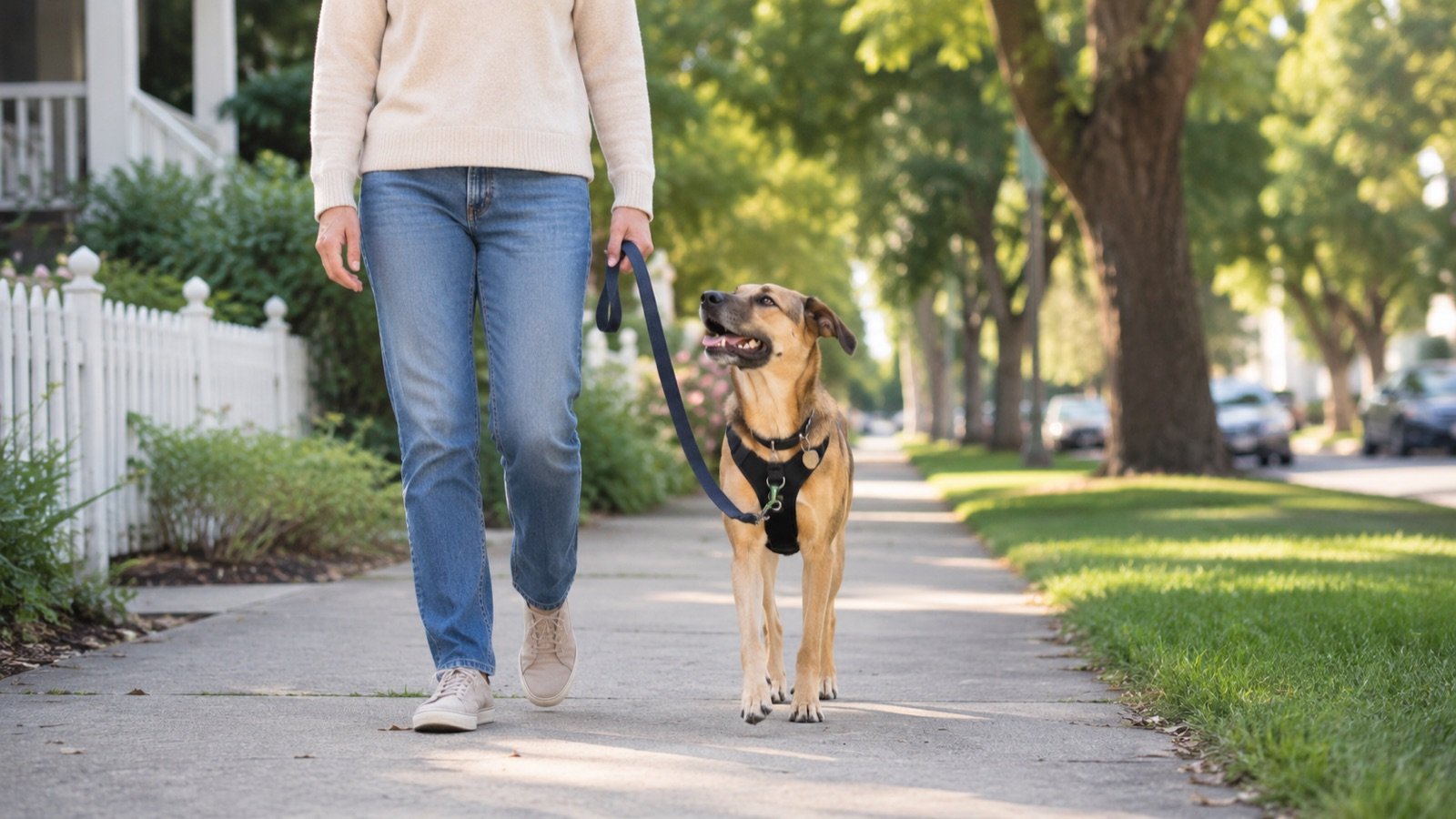
To stop a dog pulling on the leash, stop rewarding the pull: the instant the leash goes tight, stop walking, and only move forward when it loosens. Pair that with rewards for staying by your side, a front-clip harness, and short, low-distraction practice. Consistency beats any gadget.
Getting dragged down the street is one of the most common reasons people dread walks — and one of the most fixable. My arms have been yanked by 70-pound fosters who walked beautifully two weeks later. No special strength required, just the right approach. Here it is.
Why does my dog pull on the leash?
It's not defiance. Dogs naturally walk faster than we stroll, and the world outside is a buffet of smells and sights. When your dog pulls and you follow, the pulling works — it gets them to the next lamppost sooner. Every tight-leash step you take teaches your dog that pulling is how you get places.
So the whole strategy comes down to one rule: a tight leash should never move your dog forward.
What equipment helps — and what to avoid?
Gear won't train your dog, but the right gear makes training far easier and kinder:
- Use a front-clip harness. The leash attaches at the chest, so when your dog pulls they're gently turned back toward you — no neck strain, no pain.
- Use a standard 4–6 ft leash. Skip retractable leashes: they teach your dog that pulling extends the lead, which is the opposite of what you want.
- Avoid choke, prong, and shock collars. The American Veterinary Society of Animal Behavior recommends against aversive tools like these, because they can cause pain, injury, and fear — and a front-clip harness plus training reaches the same goal without the risk.
Gear is a helper, not a cure. A front-clip harness makes pulling harder and training smoother, but your dog still learns loose-leash walking from the practice below — not from the equipment alone.
How do you teach loose-leash walking?
Start indoors or in a quiet yard, with treats and a hungry, happy dog. Then:
- Reward the sweet spot. Whenever your dog is at your side with a loose leash, mark ("Yes!") and treat. Show them exactly where the good stuff happens.
- Stop when it's tight ("be a tree"). The moment the leash goes taut, stop dead. Don't yank — just become boring and still. Wait.
- Move again when it loosens. The instant your dog eases up or looks back at you, say "Yes!" and walk on. Moving forward is the reward for a loose leash.
- Or turn around. For strong pullers, calmly turn and walk the other way when the leash tightens. Your dog learns to pay attention to where you're going.
It will feel slow and stop-start at first — that's the training working. You're teaching a new default, one step at a time.
Most pulling is really a focus problem. Brain Training for Dogs builds the attention and impulse control that make loose-leash walking click — through force-free games. See what's inside in our honest review.
Read our Brain Training for Dogs review → Independent review · we may earn a commission at no extra cost to you.How do you keep your dog focused outside?
The street is full of distractions, so your job is to be more rewarding than the environment. Bring high-value treats, reward check-ins (every time your dog glances at you), and keep early sessions short and in easy places before graduating to the busy park. If your dog tunes you out the second you step outside, that's the same root issue I cover in why your dog ignores you.
Loose-leash walking is just one skill in the bigger picture — the full sequence lives in my complete home training guide.
How long does it take?
With short daily practice, most dogs walk noticeably better within two to four weeks. A deeply grooved pulling habit can take a couple of months to fully rewire — and even then, expect the occasional exciting squirrel to win. Reward the good walks and stay consistent; that's what makes it stick.
One exception worth watching: if an older dog suddenly pulls less, stiffens up, or seems reluctant partway through the walk, that's not progress — it can be joint discomfort rather than better manners. Worth ruling out before you credit the training; our UltraK9 Pro review covers the signs.
The one mistake to avoid: taking "just this once" tight-leash steps because you're in a hurry. Every pull that works undoes your progress. On days you can't train, use the front-clip harness and keep the walk short.
Frequently asked questions
Why does my dog pull on the leash?
Dogs walk faster than we do and the world is exciting, so pulling gets them to the next sniff sooner. Every time pulling moves them forward it's rewarded — so the fix is making sure a tight leash never works.
What is the best harness to stop pulling?
A front-clip (front-attachment) harness is the kindest, most effective everyday tool. It gently redirects your dog toward you when they pull, without the neck pressure of a collar. Avoid choke and prong collars.
Do choke or prong collars work?
They may reduce pulling through discomfort, but veterinary behavior groups advise against them because they can cause pain, injury, and fear. A front-clip harness plus training achieves the same goal without the risks.
How long does it take to stop a dog pulling?
With daily, consistent practice most dogs improve within a few weeks, though a strong habit can take a couple of months to fully rewire. Short, frequent sessions beat long walks.
What is the #1 trick to stop a dog pulling on the leash?
Stop moving the instant the leash goes tight, and only walk on when it loosens. Because forward motion is exactly what your dog wants, making a tight leash "freeze" the walk is the single most powerful fix — and a front-clip harness makes it easier.
Do dogs grow out of leash pulling?
No. Pulling doesn't fade with age on its own, because it keeps being rewarded every time it gets your dog where they want to go. It only improves when you train a loose leash and stop letting pulling work.
Sources
Where this guide makes a claim about training method, behaviour or health, this is where it comes from. Checked August 2026.
- ASPCA. Position Statement on Training Aids and Methods — opposes any training equipment that causes a pet physical discomfort or undue anxiety. Accessed August 2026. aspca.org
- American Veterinary Society of Animal Behavior (AVSAB). Humane Dog Training Position Statement, 2021 — recommends that only reward-based training methods are used for all dog training, including the treatment of behaviour problems. Accessed August 2026. avsab.org

Canine behavior writer & rescue foster
Megan has fostered more than 30 rescue dogs — including plenty of committed pullers — and taught every one to walk on a loose leash with a front-clip harness and reward-based training, never a prong collar. She writes PawHonest to share honest, force-free dog advice.
A note on trust: If your dog pulls due to fear or reactivity toward other dogs or people, work with a certified trainer or veterinary behaviorist — that's a different problem from ordinary pulling. PawHonest is reader-supported: we may earn a small commission on purchases through our links, at no extra cost to you, and only recommend what we'd use on our own dogs.