
Redirected aggression is when a dog gets frustrated or worked up by something he can't reach, then turns on whoever is closest: you, or another dog. It looks sudden and out of context. The target often has no idea what triggered it, which is why it can look random and leave the victim afraid.
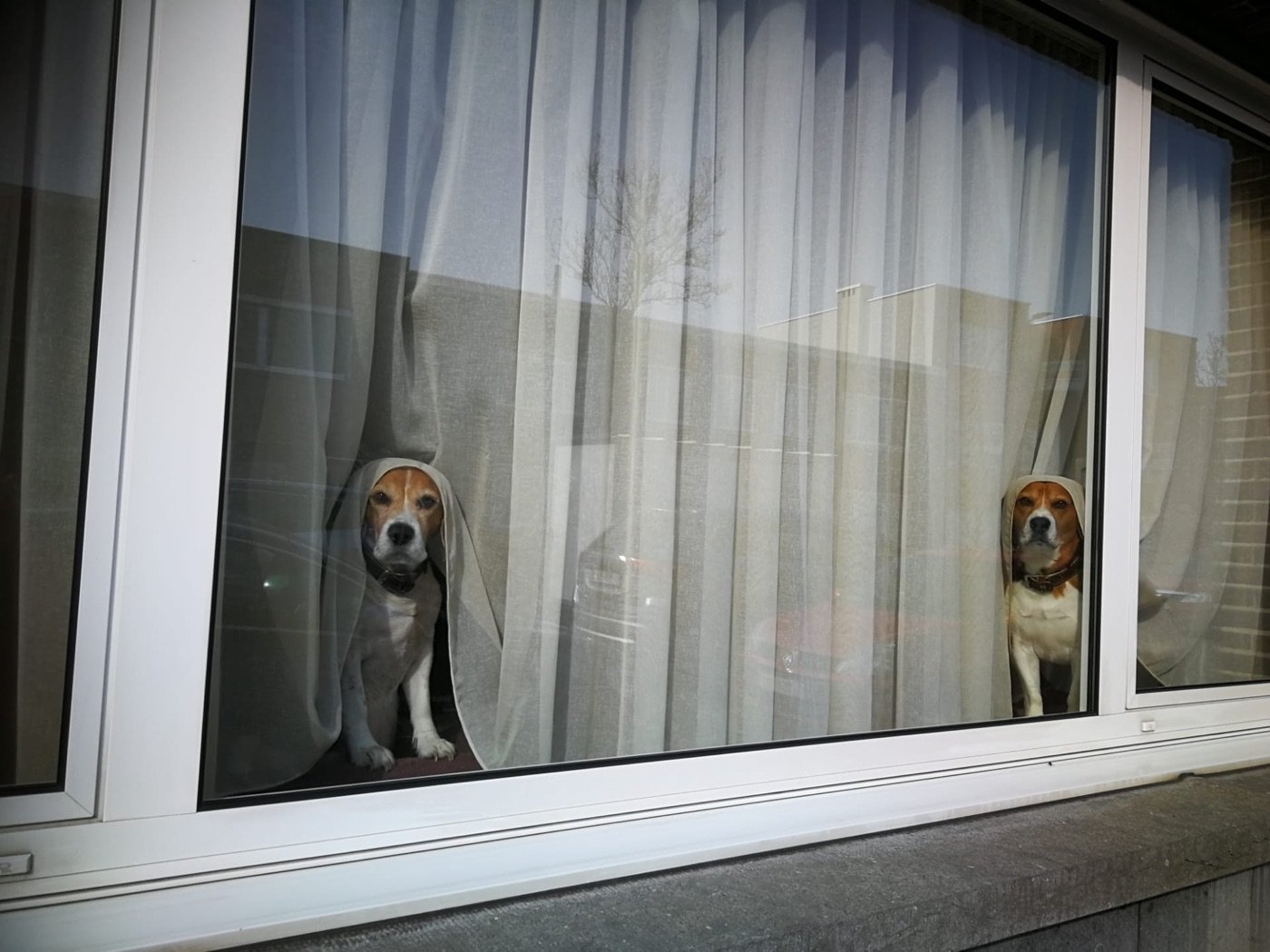
Two dogs are at the window. A stranger walks a dog past the house. One dog goes rigid and starts to bark. The other, asleep on the couch a second ago, wanders over to see what's happening, and gets bitten hard.
The owner's first thought is usually "these two don't get along." Often that's wrong. The fight wasn't about the two of them at all. It started with something outside the glass. This guide shows what redirected aggression looks like, how to separate it from an accident or a real feud, and what to do about it.
If someone was bitten: wash any broken skin right away and see a doctor for a human bite. For a dog, check under the fur for punctures and call your vet the same day if skin was broken. Do not reach into a fight with your hands.
What Is Redirected Aggression in Dogs?
The veterinary behaviorists at VCA Animal Hospitals define it as aggression directed toward a person or animal that is not the initial target of the dog's emotional response. They describe it as frustration-based, and say it happens when a dog cannot reach the original target.
Think of it as pressure with nowhere to go. The dog is already aroused. Something blocks him from acting on it: a window, a fence, a leash, a gate, or you stepping in. The arousal doesn't switch off. It lands on whatever is closest.
One honest note up front. Veterinary behaviorist Dr. Karen Overall writes that redirected aggression is more common in cats than in dogs, and that she found no evidence that one sex is affected more often than the other. In dogs it's real and serious, but it's not the most common explanation for a bite.
What Does Redirected Aggression Look Like?
The pattern is easier to spot once you know the order of events.
1. Something upsets or excites the dog
A dog or person outside, a loud noise, a fight between two other dogs, or an interrupted chase. VCA lists frustration as the driver, so the trigger can also be something he wants and can't reach.
2. He is blocked from acting
There's a window, a fence, a leash, a closed gate. Or a person grabs his collar. Overall's own example: a dog chases a cat, the owner stops the chase, and the dog redirects onto the owner.
3. The target is whoever is nearby
This can be you, a housemate dog, or a child. It is usually someone who did nothing and often didn't see the trigger.
4. It's fast, intense, and out of context
Overall notes that redirected aggression can be fierce. The recipient may be so surprised that the attack feels random. That's the key difference from a normal growl or warning.
Common scenes owners describe
- The window. One dog sees a trigger outside, and the housemate who walks over gets attacked. Overall describes the same setup in cats.
- The leash. A dog lunges at another dog on a walk, can't get there, and bites the leash, then your hand or leg.
- The fight break-up. You step in. Overall points out that a dog can also turn on whoever interrupted the fight.
- The doorbell. Two dogs race to the door at high arousal and one turns on the other.
- The interrupted chase. You grab a dog who is chasing the cat or a squirrel and he whirls on you.
Is It Redirected Aggression or an Accidental Bite?
The two get mixed up all the time. Overall draws a clear line. An accidental bite happens simply because someone got between fighting animals. The biting dog generally releases as soon as he realizes his mistake. True redirected aggression doesn't work that way, and it may be quite fierce.
| What you saw | What it probably was |
|---|---|
| Dog bit your hand during a fight, then let go right away | Likely an accidental bite |
| Dog was already locked onto a trigger, then whirled on you or a housemate and kept going | Redirected aggression |
| Two dogs growl at each other over a toy or bone, nothing outside involved | Resource guarding (see why dogs in one home fight) |
| Dog lunges and barks at other dogs on leash, but never turns on you | Leash reactivity (see Reactive Dog 101) |
| Sudden bite from a dog who is limping, old, or newly irritable | Possibly pain, see a vet first |
It also helps to know that the trigger often goes unseen. Overall notes that the people watching a redirected event usually assume the problem is between the two dogs, because they didn't see what set it off. That's why a quick note on what happened right before is so useful.
Why Is It So Hard on the Victim?
Overall's protocol gives this point real weight. Victims of redirected aggression can suffer a profound decline in quality of life. The attack is so sudden and out of context that the recipient can become instantly, intensely fearful of the aggressor, sometimes after a single event.
Two things can follow:
- The victim hides or withdraws. The social structure of the household can change.
- The aggressor learns the wrong link. He may associate his frustration with the housemate, so seeing that dog later triggers the same reaction, even with no window or stranger involved.
If the dogs already had tension, this gives it a new start. That's why a "one-off" redirected bite between housemates deserves a plan, not a shrug.
Redirected aggression feeds on arousal and frustration. Teaching a dog to wait, settle on a mat, and disengage on cue gives him something to do other than boil over. Brain Training for Dogs builds those impulse-control skills in short daily games.
Read our Brain Training for Dogs review → Independent review · we may earn a commission at no extra cost to you.What Should You Do After a Redirected Bite?
1. Separate the dogs calmly
Use a gate, door, or crate. Don't yell and don't punish. VCA advises against confronting or scolding an aggressive dog, since he's likely to become more frightened or frustrated.
2. Give the victim the freedom
Overall recommends that the dog who was attacked get the most freedom to roam and pick a resting spot, and get a few minutes of calm one-on-one attention each day.
3. Find and remove the trigger
Ask what happened in the 30 seconds before. If it was a window, block the view with film or a curtain, as Overall suggests. If it was the leash, increase the distance from other dogs on walks.
4. Don't let them rehearse
When you can't supervise, keep the two dogs apart. Overall suggests restarting introductions as if the dogs had never met, and rewarding the aggressor for ignoring the victim.
5. Interrupt early
Overall tells owners to watch closely and interrupt at the first signs, including staring. A dog that stiffens and locks on is the moment to calmly call him away or use a barrier, not after the lunge.
6. See your vet, then a veterinary behaviorist
Pain and illness can lower tolerance, so start with an exam. VCA says that if there's no physical cause, a veterinary behaviorist should assess the dog. Overall also notes that in some cases both dogs may need anti-anxiety medication, as an addition to behavior work, never a replacement.
Breaking up a fight safely: never put your hands near the mouths. Use a barrier, a loud noise, or the two-person "wheelbarrow" method from the Central California SPCA. Afterward, check both dogs for hidden punctures.
How to Prevent It
Most prevention is about managing the moments when arousal peaks.
- Block the window view where your dogs hang out, or limit access when people and dogs pass.
- Greet the door one dog at a time, or keep both behind a gate when guests arrive.
- Walk reactive dogs at a distance where they can still think. Our leash reactivity guide explains how.
- Don't grab a dog mid-trigger. Calmly add distance or a barrier instead.
- Work on mental outlets. A bored dog is more easily set off. Try the brain games that build calm focus.
Can Redirected Aggression Be Fixed?
It can often be reduced, but be realistic. VCA's behaviorists say aggression typically can't be fully "cured," and that long-term management is usually needed. Overall calls redirected aggression very difficult to treat, and says it may have a high relapse rate.
If months of consistent effort don't help and one dog keeps getting hurt, Overall says rehoming one dog may be safest, because changing the circumstances can break the pattern. If that's not an option, dogs can live completely separately in the same house with serious effort. Neither is failure. Both protect the dog who's being hurt.
Behavior plans work better when your dog already knows how to settle and switch off. We reviewed Brain Training for Dogs honestly, including who it isn't for.
See our Brain Training for Dogs review → Independent review · we may earn a commission at no extra cost to you.Frequently asked questions
What is redirected aggression in dogs?
It's aggression aimed at a person or animal that was not the original target of the dog's emotional response. VCA's veterinary behaviorists describe it as frustration-based: it happens when a dog can't reach whatever upset it and turns on whoever is nearby instead.
Is redirected aggression the same as an accidental bite?
No. Veterinary behaviorist Dr. Karen Overall explains that in an accidental bite, the dog usually lets go as soon as it realizes its mistake, because the person simply got between fighting animals. In true redirected aggression the dog keeps going and the attack can be fierce.
Why did my dog bite me when I broke up a fight?
Because a dog in a fight is at peak arousal and you interrupted what it was doing. That can be an accidental bite or true redirected aggression. Either way it is why you should never reach into a fight with your hands. Use a barrier, a loud noise, or the two-person wheelbarrow method instead.
Why does my dog attack my other dog after seeing something out the window?
Seeing a dog, person, or animal outside that he can't reach creates frustration and arousal with nowhere to go. A housemate who walks into that moment can become the target. The housemate may have no idea what set it off, so the attack looks random to them.
Can redirected aggression be cured?
VCA's behaviorists note that aggression in general can often be reduced in frequency and intensity, but the potential usually isn't fully eliminated and long-term management is typically needed. Karen Overall calls redirected aggression very difficult to treat, with a possibly high relapse rate.
Should I punish my dog after a redirected bite?
No. VCA advises against confronting or scolding a dog that shows aggression, because it is likely to become more frightened or frustrated. Separate the dogs calmly, check for injuries, and call your vet.
Sources
Where this guide makes a claim about behavior or safety, this is where it comes from. Checked October 2026.
- VCA Animal Hospitals. Lindell, E., VMD, DACVB; Martin, K., DVM, DACVB; Buzhardt, L., DVM. Aggression in Dogs. Accessed October 2026. vcahospitals.com
- Overall, K.L. Protocol for Understanding and Treating Redirected Aggression. Accessed October 2026. karenoverall.com
- Central California SPCA. How to Break Up a Dog Fight the Right Way. Accessed October 2026. ccspca.com

Canine behavior writer & rescue foster
Megan has fostered more than 30 rescue dogs and manages tense moments with distance, gates, and counter-conditioning, never confrontation. She writes PawHonest to share the honest, hype-free advice she wishes she'd had sooner.
A note on trust: I'm an experienced foster and an informed owner, not a veterinarian or veterinary behaviorist. If any dog has bitten a person or drawn blood, or the aggression is escalating, get a veterinary behaviorist or certified behavior consultant involved. This guide is educational, not a substitute for that. PawHonest is reader-supported: we may earn a small commission on purchases through our links, at no extra cost to you, and only recommend what we'd use on our own dogs.