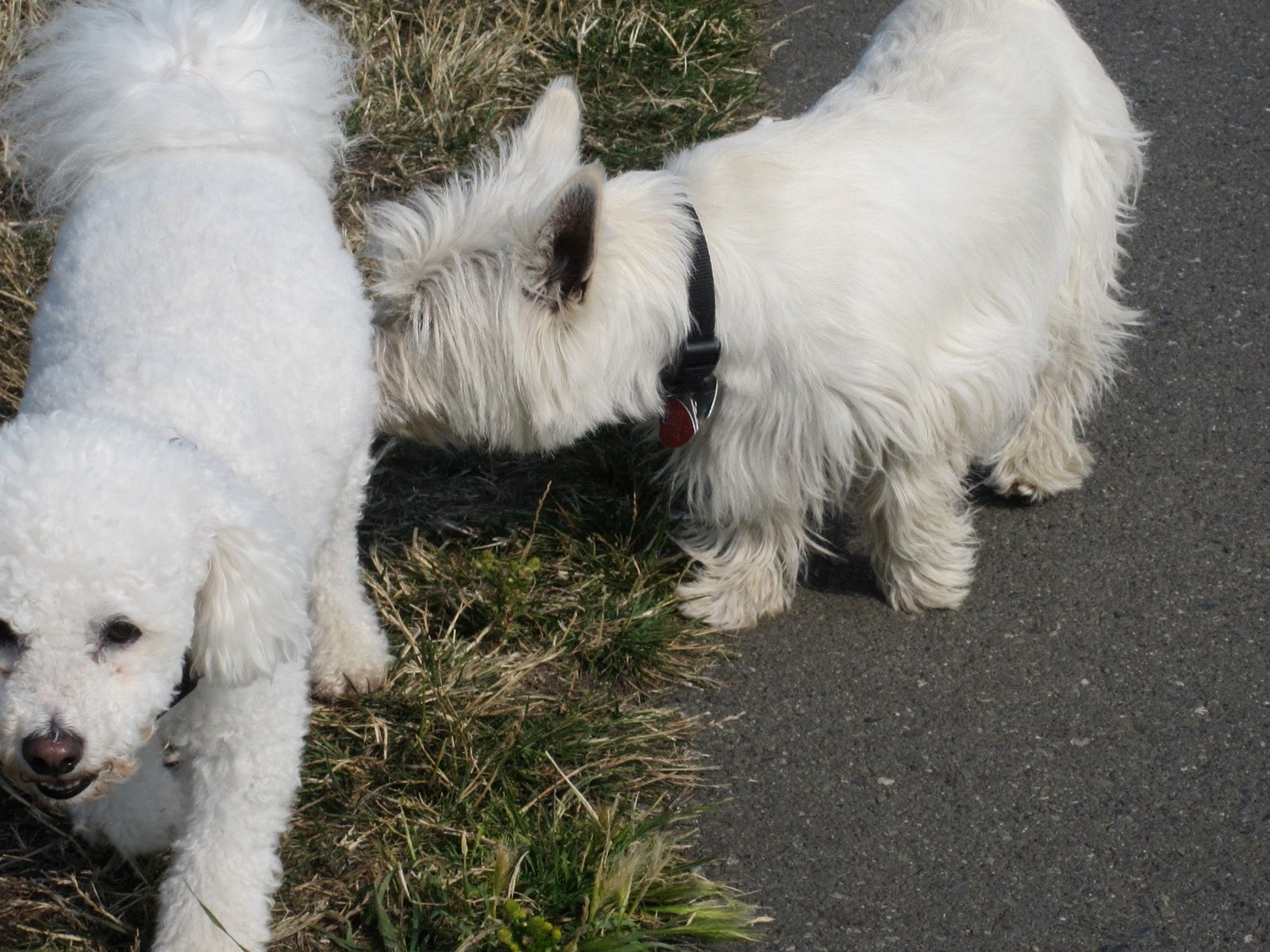
Dogs in the same home usually fight over a specific trigger — a resource like food, a toy, or a resting spot; frustration redirected from something they can't reach (a dog or person seen through a window); or a medical issue like pain or an infection. Fighting often starts when the younger dog hits social maturity, around 1 to 3 years old. The fix is identifying the real trigger, separating safely, and rebuilding trust step by step — never letting them "fight it out."
I fostered two terrier mixes who'd lived together peacefully for a year, then started fighting over a dog bed that had been in the house the entire time. Nothing about the bed had changed. What had changed was the younger one turning two and getting bolder about resources he'd never contested before. Once I saw that, the fix wasn't complicated — but finding it took ruling out a lot of wrong guesses first. Here's how to do that faster than I did.
Safety first: if a fight is happening right now. With two people, use the wheelbarrow method — each person grabs their own dog's back legs and lifts, pulling the dogs apart and turning in a circle away from each other so neither dog can re-engage. Alone, never reach for the dogs' mouths or faces — pull back on a collar or harness instead. If it's too dangerous to get close, stay back; most fights end within seconds on their own. Afterward, check both dogs carefully for puncture wounds under the fur (they hide easily) and see a vet the same day for anything beyond a scrape — bites carry high infection risk.
Why did my dogs suddenly start fighting?
"Suddenly" is almost always misleading. Veterinary behaviorists writing for VCA Animal Hospitals note that dogs communicate tension through very subtle body language — a hard stare, a stiff posture, a slow turn away — and those signals are easy for owners to miss entirely until the first real fight breaks out. By the time you notice a problem, the dogs have often been negotiating it quietly for weeks.
That said, there are a handful of concrete reasons fighting starts when it does:
- Social maturity. Aggression between household dogs often begins when the younger dog matures socially, somewhere between one and three years of age — old enough to start contesting resources an older dog previously controlled without question.
- A medical condition. Pain, loss of mobility, or an infection (skin, ear, or anal gland) can change how a dog reacts to being approached, or change their scent in a way that unsettles a housemate. If fighting starts abruptly, both dogs need a vet exam before anything else.
- An environmental change. Construction, a houseguest, new furniture, or anything that limits access to a favorite resting spot can spark competition that wasn't there before.
- A change in routine. More exposure to a stressor — thunderstorms, a new work schedule, anything that raises baseline stress — can lower the threshold for conflict between dogs who were previously fine together.
What actually triggers a specific fight?
Behaviorists group the common triggers into a short list. Watching for these is more useful than trying to label one dog "the aggressive one":
- Resource guarding. A bone, a toy, a favorite person, a resting spot, or a food bowl. This is the single most common trigger and, when it's the whole story, usually the easiest to manage.
- Tight spaces. Narrow doorways, being crated close together, or rough play that escalates — often about excitement, frustration, or fear rather than genuine hostility.
- Redirected aggression. One dog gets aroused by something it can't reach — a dog or person seen through the window — and turns on the nearest housemate instead. This can look completely random if you didn't see what triggered the original frustration.
Write down exactly what was happening in the seconds before each fight: who was where, what resource was nearby, what either dog could see or hear. A pattern usually shows up faster than you'd expect.
The age range in which aggression between household dogs most often begins, as the younger dog reaches social maturity and starts contesting resources it previously deferred on.
Source: VCA Animal Hospitals, veterinary behaviorists Lindell, Horwitz & LandsbergIs it true that female dogs fight more than males?
This is uncomfortable to hear if you have two females, but it's a documented pattern, not internet folklore. Board-certified veterinary behaviorist Dr. Christine Calder, writing for Veterinary Partner (VIN), reports that aggression between female dogs is the most commonly reported form of same-household fighting and the most difficult to treat, largely because of how severe the injuries tend to be. Fights between male dogs, by contrast, are more often centered on a specific resource and tend to respond better to treatment.
Indicators associated with a harder road ahead include: fights that are escalating in intensity, two female dogs of similar size and age, no clear early warning signs before a fight, and any bite serious enough to require veterinary treatment. None of this means the relationship can't improve — it means it's worth involving a professional early rather than waiting to see if it resolves on its own.
Should you ever let dogs "fight it out"?
No — and this is worth being direct about, because it's common advice from well-meaning people who've never actually had two dogs draw blood on each other. Letting a fight run its course doesn't "settle the hierarchy." It risks real injury to both dogs, and it tends to make the losing dog more defensive and more likely to fight again next time, not less. The dynamic that keeps escalating fights from happening is calm human management, not dog-on-dog resolution.
Golden rule: every fight makes the next one more likely unless something concrete changes — the trigger is removed, the environment is managed, or a real behavior plan is in place. Time alone does not fix this.
How do professionals actually rebuild the relationship?
The protocol used by veterinary behaviorists is more structured than most owners expect, and skipping steps is the most common reason it fails. In order:
- Complete separation, no visual contact. Baby gates, separate rooms, or crates covered so the dogs can't see each other. This isn't a punishment — it's removing the ability to rehearse the fight while you work on the rest of the plan.
- Basket-muzzle training for both dogs. Taught as a positive skill, never forced — the dog chooses to put its own nose in the muzzle for treats, session by session. A buckle-style basket muzzle (not a soft fabric one) is the standard choice because it allows panting and treats.
- A safe haven for each dog. A crate or room where only good things happen — food puzzles, calm music, nothing stressful. This gives each dog somewhere to fully relax, which they need before reintroduction can work.
- Parallel walks and mat work. Once both dogs are comfortable in their muzzles, walk them side by side — one adult per dog — before any off-leash time together. Teaching each dog to relax on a mat gives you a tool to use during reintroduction.
- Short, supervised time together. Muzzled, tethered, one adult per dog, sitting on opposite sides of the room with a long-lasting chew or toy each. Watch for hard stares held longer than three seconds and redirect before tension builds.
- Never leave them together unsupervised until a professional has told you it's safe — which can take weeks. Medication for anxiety may be recommended for one or both dogs during this process, and that's a normal part of treatment, not a failure.
This is also, structurally, the same patience and consistency my step-by-step home training guide asks for — small, boring, repeated wins beat one big dramatic breakthrough every time.
While you're managing separation, an under-stimulated dog gets more frustrated, not less — and frustration is fuel for the next fight. Brain Training for Dogs gives each dog structured, solo mental work that burns the exact energy that so often spills over into resource guarding and redirected aggression.
Read our Brain Training for Dogs review → Independent review · we may earn a commission at no extra cost to you.How do I read the warning signs before the next fight?
Shelters that handle dog-to-dog conflict daily teach owners to watch for the same short list of signals: cowering, lip licking, an exaggerated yawn, turning away, flattened ears, a tucked or stiffly held tail, "whale eye" (the head turned away but one eye still fixed on the other dog), and piloerection — the hair standing up along the spine. None of these mean a fight is guaranteed, but any of them is your cue to calmly separate the dogs before it escalates, not after.
Reading body language accurately is exactly the skill that makes separation anxiety and reactive-on-leash behavior easier to manage too — the earlier you catch rising stress, the smaller the intervention needed to defuse it.
When does this need a professional, not just patience?
Call a veterinary behaviorist (look for the credential DACVB) or a certified behavior consultant if any of the following is true: a fight has drawn blood, fights are increasing in frequency or getting more intense, you can't identify a consistent trigger even after tracking incidents, or you simply don't feel safe managing the dogs yourself day to day. Aggression between familiar housemates is one of the most common reasons dogs are surrendered or rehomed — reaching out early, before the relationship is badly damaged, gives both dogs the best odds of staying together safely.
Frequently asked questions
Is it normal for dogs in the same house to fight sometimes?
An occasional noisy spat with no injury, over in a few seconds, is common and not usually a crisis. Repeated fights, escalating intensity, or any wound that draws blood is not normal and needs a vet visit plus a behavior plan, not just time.
Why did my two dogs suddenly start fighting after years of getting along?
Sudden fighting between previously peaceful dogs is often triggered by the younger dog reaching social maturity (roughly 1 to 3 years old), a medical issue such as pain or an ear or skin infection, or a change in the home like a new pet, guest, or altered routine. Both dogs should see a vet first to rule out a physical cause.
Should I let my dogs work it out themselves?
No. Letting dogs "fight it out" risks real injury and tends to make the relationship worse, not better, because the losing dog often becomes more defensive next time. Separate calmly and address the actual trigger instead.
How do I safely break up a dog fight?
With two people, use the wheelbarrow method: each person grabs their dog's back legs and lifts, pulling the dogs apart and turning away so neither dog can re-engage. Alone, never put your hands near the mouths — pull back on a collar or harness instead, and if it's too dangerous to intervene safely, stay back.
Are female dogs really more likely to fight than males?
Veterinary behaviorists report that aggression between female dogs is the most common form of same-household fighting and the hardest to resolve, due to the severity of injuries involved. Fights between male dogs are more often about a specific resource and tend to be easier to treat. These are patterns, not guarantees — any pair of dogs can fight.
Do dogs need to be muzzled to be safely reintroduced?
Basket-muzzle training is a standard safety step in professional reintroduction plans, but it's taught as a positive skill first — the dog is never forced into the muzzle — so both dogs can be together supervised without the risk of a serious bite while the relationship is rebuilt.
When should I call a professional instead of handling it myself?
Call a veterinary behaviorist or certified behavior consultant if a fight has drawn blood, if fights are increasing in frequency or intensity, if you can't identify a clear trigger, or if you don't feel safe managing the dogs yourself. This is exactly the situation professional help exists for.
Sources
Where this guide makes a claim about behavior or safety, this is where it comes from. Checked September 2026.
- VCA Animal Hospitals. Lindell, E., Horwitz, D. & Landsberg, G. Dog Behavior Problems: Aggression Between Household Dogs — Assessment. Accessed September 2026. vcahospitals.com
- Veterinary Partner (VIN). Calder, C., DVM, DACVB. Aggression Between Familiar Dogs, 2021. Accessed September 2026. veterinarypartner.vin.com
- Merck Veterinary Manual. Behavior Problems in Dogs — Behavior Problems Associated with Aggression. Accessed September 2026. merckvetmanual.com
- Central California SPCA. How to Break Up a Dog Fight the Right Way — the wheelbarrow method and post-fight care. Accessed September 2026. ccspca.com

Canine behavior writer & rescue foster
Megan has fostered more than 30 rescue dogs, including several multi-dog households with real tension to manage, and has rebuilt every one of those relationships with force-free management — never by letting dogs "sort it out." She writes PawHonest to share the honest, hype-free advice she wishes she'd had sooner.
A note on trust: Any fight that draws blood, or a pattern of repeated fighting, deserves a veterinary and behaviorist evaluation — this guide is not a substitute for that. PawHonest is reader-supported: we may earn a small commission on purchases through our links, at no extra cost to you, and only recommend what we'd use on our own dogs.