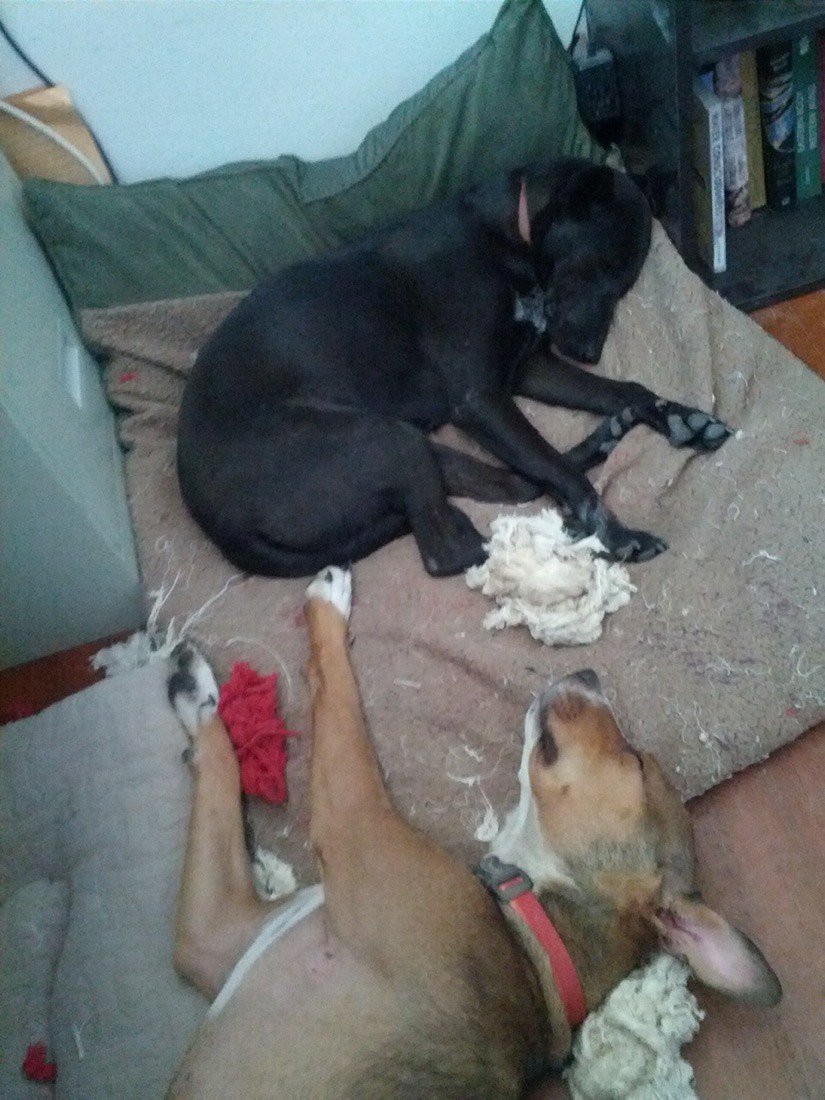

Don't reunite dogs right after a fight. Separate them completely with no visual contact, get both checked for injuries and pain, then rebuild slowly: muzzle and mat training, parallel walks, then short supervised sessions. Move on only when both dogs are fully relaxed, never on a timer.
The fight is over. Both dogs are panting, one has a small cut, and you're shaking. Part of you wants them to just make up so life can go back to normal.
That's the moment to slow down. How you handle the next days decides whether this was a one-time scare or the start of a pattern. This guide covers the first hour, the "are they ready?" question, and a careful way back together. For the full eight-step protocol, see our step-by-step fight guide. This page is about the reunion itself.
Never reach into a fight with your hands. Use a barrier, a loud noise, or the two-person wheelbarrow method from the Central California SPCA. If anyone was bitten, wash broken skin right away and see a doctor.
What Should I Do Right After the Fight?
1. Separate them calmly
Put each dog in a different room behind a closed door or in a covered crate. The veterinary behaviorist Dr. Christine Calder, writing for Veterinary Partner (VIN), says the dogs should have complete separation with no visual contact. Gates, leashes, and tethers help.
Stay quiet. The Merck Veterinary Manual warns that physical punishment makes aggression worse, so skip the yelling and the scolding.
2. Check both dogs for hidden wounds
Punctures hide under fur. The CCSPCA advises checking the whole body afterward and calling the vet the same day if the skin was broken. A small hole can hide a deep infection.
3. Let both dogs decompress
Give each dog water, a quiet spot, and something to chew. High arousal doesn't vanish in a minute, so don't test the dogs by letting them peek at each other.
4. Write down what happened
What was going on just before? Food, a toy, the door, a window, a visitor? A note helps your vet, and it shows you the trigger you need to manage. Our guide on why dogs in the same home fight lists the usual ones.
A sore or stiff dog gets less tolerant of being bumped or crowded. Once your vet has checked, we looked at one joint-support option in our independent review. It's support alongside your vet's plan, not a fix for aggression.
Read our UltraK9 Pro review → Independent review · we may earn a commission at no extra cost to you.Should the Dogs Be Reintroduced at All?
Usually the goal is to try. But be honest about the odds first. VIN's Dr. Calder lists these indicators for a poor outcome:
- Fights that are getting more intense each time
- Two female dogs of similar size and age
- No noticeable early warning signs before the fight
- A level 3 bite or above
She also notes that fights between familiar dogs are one of the most common reasons dogs are surrendered or rehomed, and that damage to the relationship can be hard to repair. If your situation matches one or more of these, ask your vet for a referral to a veterinary behaviorist before any reunion. It's not a failure. It protects both dogs.
If you suspect the fights follow a pattern between two dogs of the same sex, read our guide to same-sex aggression. If one dog attacked after seeing something outside, it may be redirected aggression, which needs a different plan.
Are Your Dogs Ready? A Quick Checklist
The sources give no magic number of days. What they give is a set of conditions. Before any contact, check that:
| Ready for the next step | Not ready yet |
|---|---|
| Both dogs accept a basket muzzle and put their own nose in | Either dog resists or you have to force it on |
| Each dog can relax on a mat on cue | Either dog stays tense or can't settle |
| Both look loose and relaxed when they glimpse each other from a distance | Hard stares, stiff posture, or fixed attention |
| Vet has cleared both dogs | Either dog is limping, sore, or has untreated wounds |
| One calm adult is available for each dog | You're alone, or distracted |
Dr. Calder says it is important that both dogs be completely relaxed in close proximity, and that direct stares longer than three seconds be redirected quickly before tension escalates.
How Do You Reintroduce Dogs After a Fight?
Step 1: Train the muzzle first
Per VIN, basket muzzle training is very important for safety. It should be a predictor of good things, never a punishment. Go slowly, wait for the dog to place his own nose in, and never push it onto him. A muzzle with a metal buckle is better than one with plastic clasps, which can break. The dogs should never be together until they are 100% comfortable wearing them.
Step 2: Teach a mat and a "touch"
VIN recommends teaching each dog to relax on a mat, which can be used later during reintroduction, and a "touch" cue that can redirect a dog when needed. Practice each dog separately, with calm cue, response, and reward routines.
Step 3: Walk them side by side
Once both dogs are comfortable in muzzles, VIN suggests walking them next to each other, one adult per dog, as a way to rebuild the relationship. Start with enough distance that both dogs can still take treats and respond to you.
Step 4: Short indoor sessions together
Per VIN's second phase: bring the dogs out together for short periods, with one adult per dog sitting on opposite sides of the room (use a tether if needed). Give each a long-lasting chew or toy, so they can be together, stay calm, and relearn to like each other.
End each session while things are still calm. Short and boring is the goal.
Step 5: Always separate when you can't watch
VIN is clear: separate the dogs whenever they can't be directly supervised with your entire attention. That means not while you cook, answer the door, or leave for the store. A crate or a closed door is a safety tool, not a punishment.
What Mistakes Make a Second Fight More Likely?
- Rushing. Letting them "say hello" the next day because they seem fine.
- Forcing it. Pushing a muzzle on, or leashing dogs nose to nose.
- Ignoring the trigger. If the fight was over a bone or a doorway, those must be managed. Feed and give chews apart.
- Missing the early signals. Hard stares and stiffness come before a fight. React to them, not to the lunge.
- Punishing a growl. A growl is a warning. Punish it and you may lose it, and VIN lists fights with no noticeable early warning signs as a poor-outcome indicator.
- Skipping the vet. Pain can make a tolerant dog snappy.
When Should You Call a Professional?
Call your vet and ask for a veterinary behaviorist if any dog was injured badly, if a person was bitten, if the fights are escalating, or if the dogs can't stay calm at any stage. Dr. Calder also notes that medication for one or both dogs may be needed to lower anxiety in many cases. That is a decision for your vet, alongside training, never instead of it.
A mat, a "touch," and settling on cue are the foundation of a safe reunion. Brain Training for Dogs teaches that kind of impulse control in short daily games. We reviewed it honestly, including who it isn't for.
Read our Brain Training for Dogs review → Independent review · we may earn a commission at no extra cost to you.Frequently asked questions
How long should I separate dogs after a fight?
There is no fixed number of days in the veterinary sources. VIN's board-certified behaviorist says the dogs should have complete separation with no visual contact, and should only be together again once both are 100% comfortable wearing muzzles and relaxing on a mat. Progress is judged by the dogs' body language, not the calendar.
Should I let my dogs work it out themselves?
No. Letting a fight run its course risks serious injury, and a fight can damage the relationship between the dogs in a way that is hard to repair. Separate them calmly and start a managed plan instead.
Can two dogs live together again after a serious fight?
Often yes, with management, but not always. VIN lists warning signs for a poor outcome: fights escalating in intensity, two female dogs of similar size and age, no noticeable early warning signs, and a level 3 bite or above. In those cases, get a veterinary behaviorist involved before any reunion.
Do I need a muzzle to reintroduce my dogs?
VIN's behaviorist calls basket muzzle training very important for safety and says the dogs should not be together until they are fully comfortable wearing one. It is introduced slowly: the dog places his own nose in, and it is never forced on.
Is it safe to leave them alone together once they seem fine?
Not at first. VIN advises always separating the dogs whenever you can't directly supervise them with your entire attention.
What if my dogs fight again during a reintroduction?
Go back to the last step where both dogs were calm and add distance. Do not punish either dog. If a second fight happens or injuries are involved, call your vet and ask for a referral to a veterinary behaviorist.
Sources
Where this guide makes a claim about behavior or safety, this is where it comes from. Checked October 2026.
- Veterinary Partner (VIN). Calder, C., DVM, DACVB. Aggression Between Familiar Dogs. Published January 5, 2021. Accessed October 2026. veterinarypartner.vin.com
- Merck Veterinary Manual. Landsberg, G., DVM, DACVB. Behavior Problems in Dogs. Accessed October 2026. merckvetmanual.com
- Central California SPCA. How to Break Up a Dog Fight the Right Way. Accessed October 2026. ccspca.com
Canine behavior writer & rescue foster
Megan has fostered more than 30 rescue dogs and manages tense moments with distance, gates, and counter-conditioning, never confrontation. She writes PawHonest to share the honest, hype-free advice she wishes she'd had sooner.
A note on trust: I'm an experienced foster and an informed owner, not a veterinarian or veterinary behaviorist. If any dog has bitten a person or drawn blood, or the aggression is escalating, get a veterinary behaviorist or certified behavior consultant involved. This guide is educational, not a substitute for that. PawHonest is reader-supported: we may earn a small commission on purchases through our links, at no extra cost to you, and only recommend what we'd use on our own dogs.