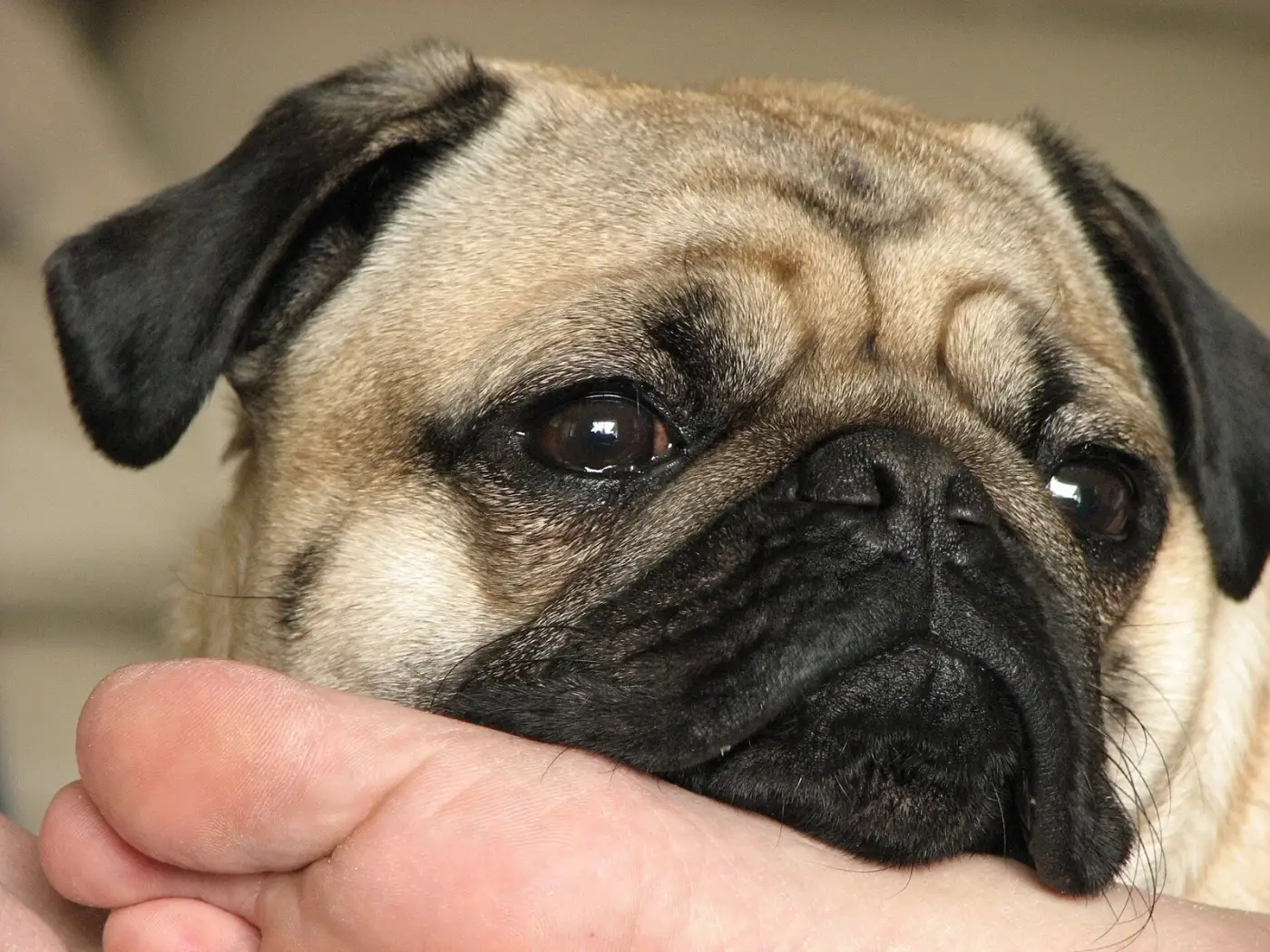

The Royal Veterinary College compared 4,308 pugs with 21,835 other dogs and found pugs were 1.9 times as likely to have a disorder recorded in a year. Breathing, eyes, skin folds and weight cause most of it. Weight and fold care are the parts you control.
I've fostered flat-faced dogs, and the thing nobody tells you beforehand is how much of the daily routine is health admin. Wiping folds. Watching the temperature. Listening to the breathing.
Most articles about pug health are vague on purpose. This one isn't, because there's a good study to point at — and because knowing which problems you can influence, and which you can't, is what actually changes anything.
What did the research actually find?
In 2022 the Royal Veterinary College published the largest look at pug health yet, through its VetCompass programme. It pulled the real clinical records of 4,308 pugs and compared them against 21,835 non-pugs over a single year.
The headline number. Pugs were 1.9 times as likely as other dogs to have one or more disorders recorded in a single year. Across the 40 most common conditions, pugs were at higher risk of 23 of them and lower risk of only seven. The authors' conclusion was blunt: the pug "can no longer be considered a typical dog from a health perspective".
Here's where the risk actually sits, compared with other dogs:
| Condition | How much more likely |
|---|---|
| Brachycephalic obstructive airway syndrome (BOAS) | 54× |
| Narrowed nostrils | 51× |
| Eye ulceration | 13× |
| Skin fold infections | 11× |
| Ear discharge | 9.6× |
| Allergic skin disease | 5.9× |
| Demodectic mange | 5.6× |
| Retained baby teeth | 4.3× |
| Obesity | 3.4× |
It isn't all one way. Pugs came out at lower risk of heart murmur (0.2×), lipoma (0.2×), wounds (0.5×) — and aggression (0.3×). The gentleness people love about the breed shows up in the data too.
Why does my pug snort, snore and struggle to breathe?
This is the big one, and the numbers say so: 54 times the risk. BOAS isn't a personality quirk. It's a structural problem caused by fitting a normal amount of soft tissue into a shortened skull — narrowed nostrils, an over-long soft palate, sometimes a larynx that collapses inward.
The part worth saying plainly: no supplement, food or training fixes this. It's anatomy. What helps is a veterinary assessment and, in many dogs, surgery to widen the nostrils and shorten the palate. It works best done early, before the airway has spent years under strain.
Emergency signs — go now, don't wait: gums that are blue, grey or brick red · breathing your dog can't settle from, especially after mild activity or heat · collapse or fainting · a rasping change in the sound of the breathing · any breathing distress on a warm day. Flat-faced dogs decline fast in heat, and heatstroke in a pug is a genuine emergency.
Two everyday habits reduce the strain: walk on a harness rather than a collar, so nothing presses on an already narrow airway, and treat warm weather as a reason to stay in. A pug can't cool itself by panting the way a longer-nosed dog can.
How much exercise does a pug actually need?
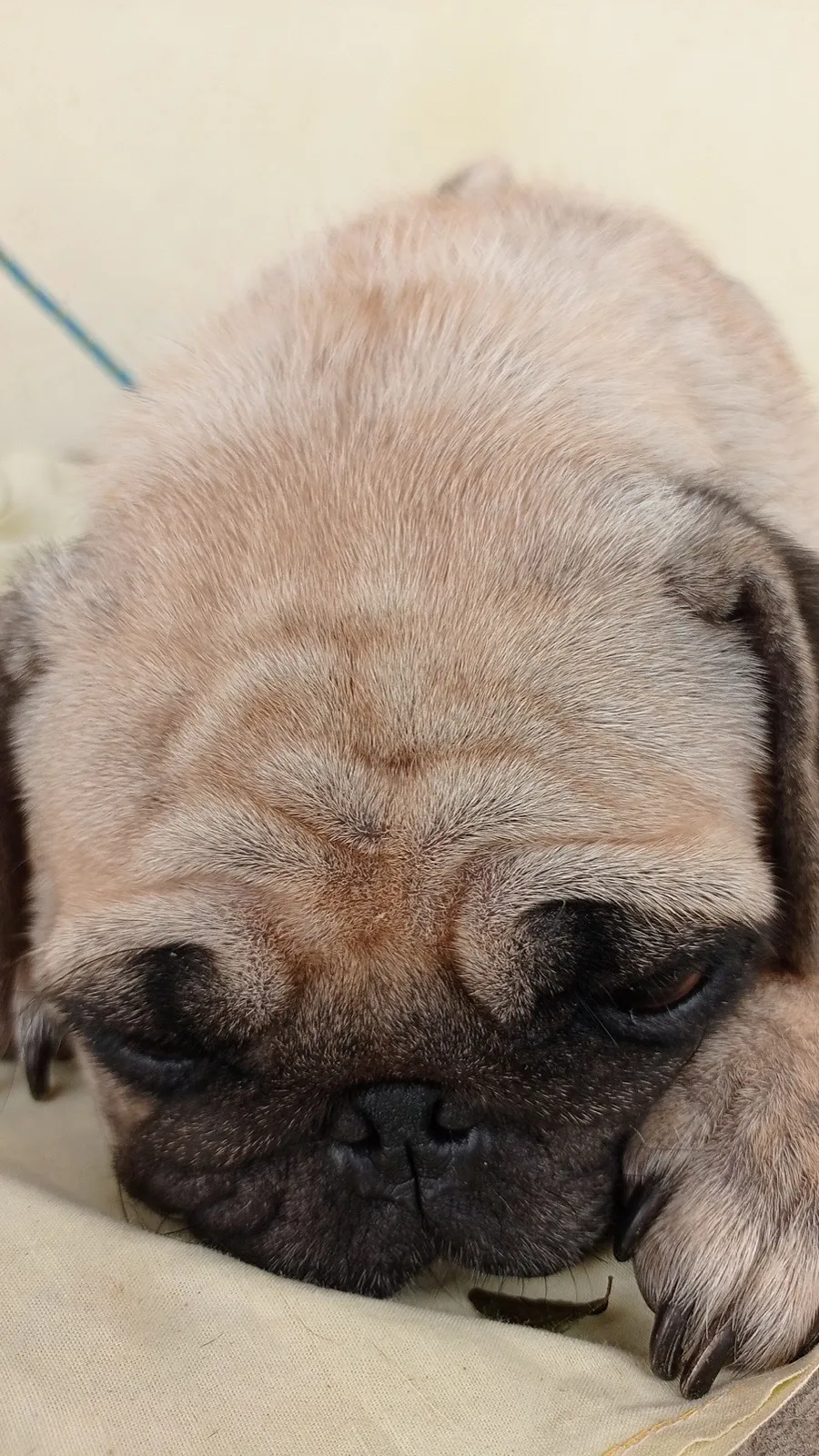
Less than you'd think, and never in heat. Several short walks beat one long one. Early morning and late evening beat midday.
Which creates a real problem, because a dog that can't be physically tired out still has a brain that needs using. An under-stimulated pug gets bored, and bored dogs chew, bark and pester — and then get told off for it.
This is the one place where the usual advice for other breeds gets it backwards. For most dogs, mental work is a nice extra on top of exercise. For a pug it isn't an extra — it's the replacement. Fifteen minutes of scent games or puzzle work tires a dog more than a walk does, and costs the airway nothing.
Our guide to mental stimulation for dogs has twelve games you can run with things already in your kitchen. Nose work and slow-feeder puzzles are the ones that suit pugs best — low effort, no heat, no strain.
A structured programme beats improvising, because it gives you a next step instead of running out of ideas by week two. Brain Training for Dogs is the one we've reviewed in full — force-free, built around games, and workable in a living room.
Read our honest review → Independent review · we may earn a commission at no extra cost to you.How do I look after a pug's face wrinkles?
Skin fold infections are 11 times more likely in pugs, and the cause is simple: a warm, damp, closed fold is where bacteria and yeast thrive.
The routine is short. Wipe inside each fold with a damp cloth or a plain unscented wipe. Then dry the fold properly — that second step is the one people skip, and it's the one that matters. Do it daily, not weekly.
Don't forget the fold above the nose and the crease under the tail. If a fold smells, looks red, or the dog starts rubbing its face on furniture, that's past cleaning — it needs a vet and usually medicated treatment.
Why does my pug shed so much for a short-haired dog?
Because fawn pugs carry a double coat. All that fur is packed onto a small dog, so the shedding feels wildly out of proportion, and it peaks in spring and autumn.
Seasonal moulting is normal. What isn't normal is heavy shedding all year with a dull, rough or thinning coat — that usually points at diet, skin health or a parasite. And with allergic skin disease running 5.9 times higher in pugs, a coat that's gone downhill deserves a look rather than a shrug.
Order of checking: parasites first, then diet quality, then everything else. We walk through it in why is my dog's coat dull.
If a parasite and a medical cause are both ruled out and the coat is still poor, this is where a coat-and-skin supplement earns its place. UltraK9 Pro is the liquid we ran for 45 days on our own dog — the honest result, including what it didn't change, is in the review.
See the 45-day result → Independent review · we may earn a commission at no extra cost to you.Why is my pug so gassy?
A flat face means a lot of swallowed air, and that air leaves the way you'd expect. It's the breed's most famous joke and its least glamorous problem.
What helps, in order: a slow-feeder bowl, smaller meals split across the day, and a raised bowl so the dog isn't gulping downward. Those three change more than switching food usually does.
Wind that arrives with loose stools, weight loss or a dog that's off its food isn't a breed trait — that's a digestive problem for a vet. If your vet has ruled that out and the gut still seems unsettled, how much probiotic a dog actually needs covers what the published guidance says before you spend money on one.
PawBiotix pairs Bacillus coagulans — the strain with real canine research — with a prebiotic that feeds it, in a liquid rather than a powder dogs eat around.
Read the PawBiotix review → Independent review · we may earn a commission at no extra cost to you.What's the single most useful thing an owner can do?
Keep the dog lean. It isn't glamorous advice, but it's the one lever that moves several problems at once.
Pugs are 3.4 times more likely than other dogs to be obese, and extra weight makes breathing harder, joints sorer and heat far more dangerous — all at the same time. A pug at a healthy weight has an easier life in every one of those areas.
Never give human painkillers. Ibuprofen, paracetamol (acetaminophen) and aspirin are toxic to dogs at doses that look small. If your pug seems sore or stiff, pain relief has to come from your vet.
The short version
Pugs carry more health problems than the average dog, and the research is clear about that. But the split matters: breathing and eye structure are jobs for a vet, while weight, fold hygiene, heat management and mental enrichment are entirely yours — and together they cover a lot of ground.
Do those four consistently and you've done most of what an owner can do. Everything else is a conversation with your vet, ideally before it becomes urgent.
Frequently asked questions
What are the most common pug health issues?
In the Royal Veterinary College's study of 4,308 pugs, the biggest risks compared with other dogs were BOAS (almost 54×), narrowed nostrils (51.3×), eye ulceration (13×), skin fold infections (11×), ear discharge (9.6×), allergic skin disease (5.9×), demodectic mange (5.6×), retained baby teeth (4.3×) and obesity (3.4×).
Are pugs unhealthy dogs?
They carry more health problems than the average dog. The RVC found pugs were 1.9 times as likely as non-pugs to have one or more disorders recorded in a single year, with higher risk in 23 of the 40 most common conditions. They were at lower risk of a few things too, including heart murmur, lipoma and aggression. The study's authors concluded the pug can no longer be considered a typical dog from a health perspective.
Why does my pug snort and snore so much?
Noisy breathing in a pug usually means brachycephalic obstructive airway syndrome — narrowed nostrils, an elongated soft palate, sometimes a collapsing larynx. It's structural, not a quirk. It's worth a veterinary assessment, because surgery to widen the nostrils and shorten the palate can make a real difference and works best done early.
Why does my pug shed so much for a short-haired dog?
Fawn pugs have a double coat, so they shed far more than their size suggests, with heavier moults in spring and autumn. Steady year-round shedding with a dull or rough coat is usually diet, skin health or a parasite rather than the season. Pugs are also 5.9 times more likely to have allergic skin disease, so a sudden increase is worth showing to a vet.
How much exercise does a pug need?
Less hard exercise than most dogs its size, and never in heat. A flat-faced dog can't cool itself efficiently by panting, so a normal walk on a warm day carries real risk. Short, frequent walks in the cool parts of the day work better than one long one. Because you can't tire a pug out physically, mental work becomes the substitute rather than an extra.
Why is my pug so gassy?
Flat-faced dogs swallow a lot of air while eating and breathing, and it has to leave somewhere. A slow-feeder bowl, a raised bowl and smaller meals usually help more than changing food. Persistent wind alongside loose stools, weight loss or a dog off its food is a digestive problem for your vet, not a breed joke.
How do I clean a pug's face wrinkles?
Wipe inside each fold with a damp cloth or plain unscented wipe, then dry the fold thoroughly — the drying is the step that matters. Pugs are 11 times more likely to get skin fold infections, so it's a daily job. A fold that smells, looks red or makes the dog rub its face needs a vet, not more cleaning.
What changes as a pug gets older?
Breathing tends to get worse rather than better, weight gets harder to hold down, and joint and spine problems become more noticeable. Eyes stay vulnerable because they sit prominently. The most useful thing for an older pug is keeping it lean — extra weight makes breathing, joints and heat tolerance all worse at once.
Sources
Where this guide makes a claim about health, this is where it comes from. Checked August 2026. This article is not veterinary advice.
- O'Neill, D.G., Sahota, J., Brodbelt, D.C., Church, D.B., Packer, R.M.A. & Pegram, C. (2022). "Health of Pug dogs in the UK: disorder predispositions and protections", Canine Medicine and Genetics. Compared 4,308 pugs with 21,835 non-pugs; pugs 1.9× as likely to have one or more disorders in a year; higher risk in 23 of the 40 most common disorders. Accessed August 2026. pmc.ncbi.nlm.nih.gov
- Royal Veterinary College, VetCompass programme (18 May 2022). "New research shows Pugs have high health risks and can no longer be considered a 'typical dog' from a health perspective" — source of the individual risk figures: BOAS ×53.92, narrowed nostrils ×51.3, eye ulceration ×13.0, skinfold infections ×11.0, ear discharge ×9.6, allergic skin disorder ×5.9, demodectic mange ×5.6, retained baby teeth ×4.3, obesity ×3.4; and the protections: heart murmur ×0.2, lipoma ×0.2, aggression ×0.3, wounds ×0.5. Accessed August 2026. rvc.ac.uk