
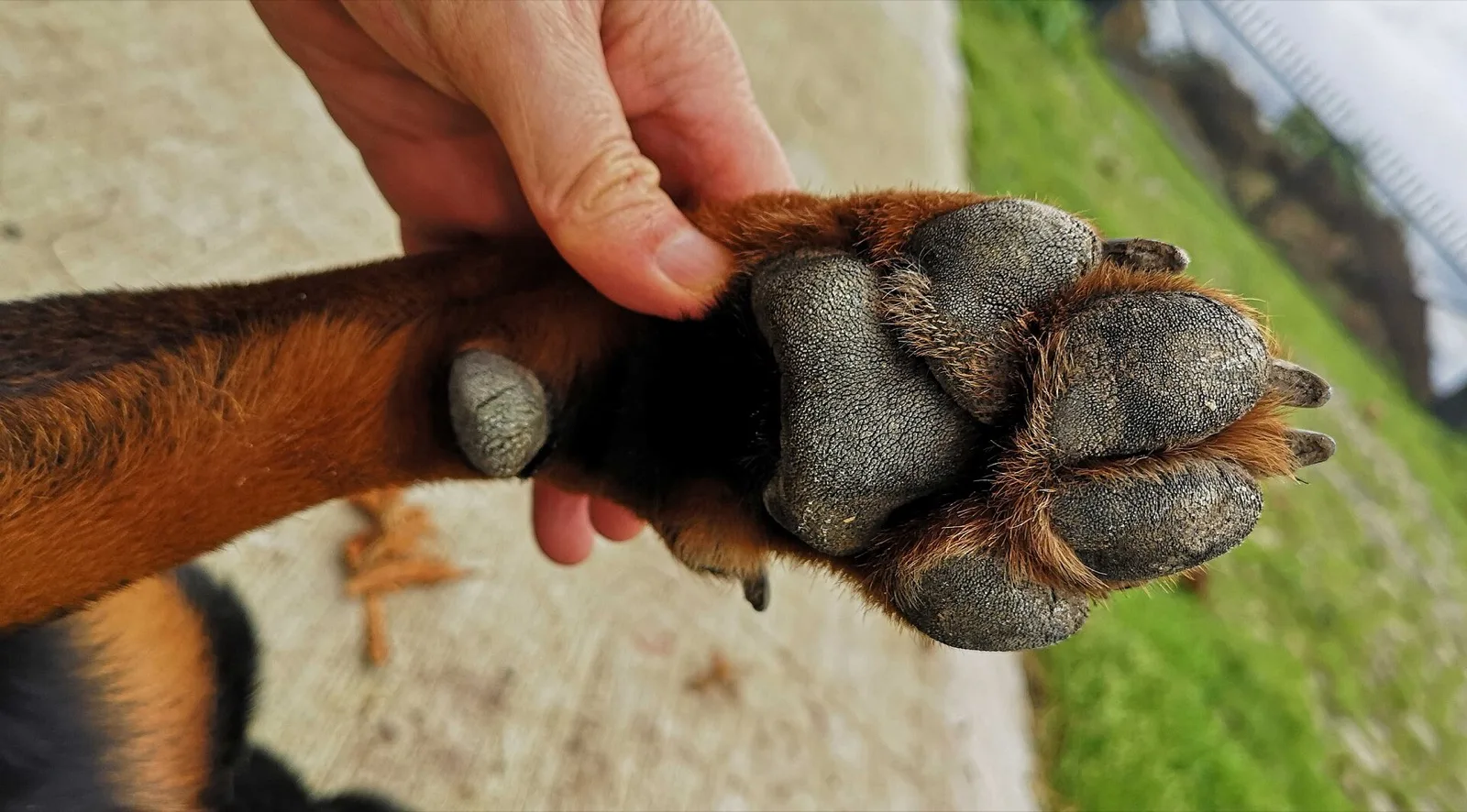

Occasional licking is grooming. Daily licking is a symptom — most often allergic skin disease, which affects as much as 10–15% of dogs. Four checks narrow it down fast: how many paws, whether the fur is rust-stained, whether the ears are involved, and whether it changes with the season.
Every article on this topic gives you the same list of causes: allergies, parasites, injury, boredom, anxiety. All true, and none of it helps, because you're left holding a list and no way to tell which one is yours.
So this guide is built the other way round. Four things you can check tonight, each one ruling something in or out.
First: is the licking actually a problem?
Dogs groom. A few licks after a walk, a wash before settling down — that's normal and always has been.
The line is roughly this: licking that happens every day, licking you can hear from across the room, or licking that interrupts what the dog was doing. A dog that stops mid-nap to work on a foot isn't grooming. Something is bothering it.
One thing worth knowing before you decide it's occasional: a lot of dogs do most of their licking at night, or in the room you're not in. Owners routinely underestimate it by half. Which brings us to the most useful clue on the dog.
Check 1: How many paws?
This one question splits the causes in half, and it costs you nothing.
| What you see | What it usually means |
|---|---|
| One paw only, the others ignored | Something local — a cut, a grass seed, a split nail, a lump, or pain in that leg |
| Both front paws | Usually allergy; front paws take the most contact with grass and floors |
| All four | Coming from inside the dog — allergic skin disease until proven otherwise |
If it's one paw, look at it properly. Good light, spread the toes apart, check the webbing between each one, the pads, and around the base of every nail. Grass seeds are the classic offender: they work in point-first, disappear under the skin and leave a small angry swelling that the dog will not leave alone.
If it's all four, skip the home inspection and book the vet. You're not going to find four separate splinters.
Check 2: Is the fur stained rust-red?
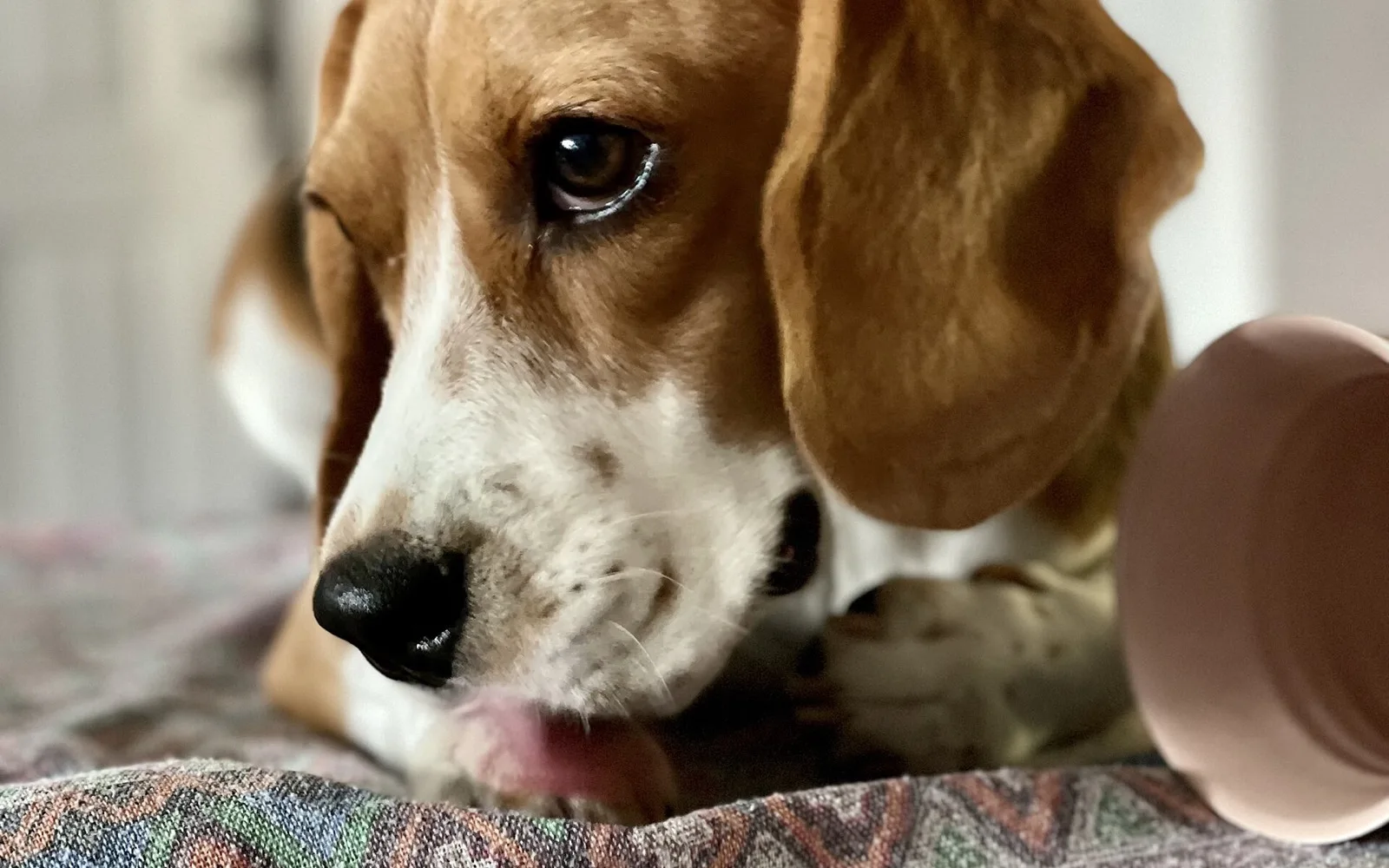
Look at the hair on top of the paw and between the toes. On a light-coated dog, chronic licking turns it a rusty pink-brown.
That colour is porphyrin — a pigment in saliva that stains fur as it dries. It isn't blood, and it isn't dirt that a bath will fix.
Why the stain matters more than the licking you witness. Porphyrin staining takes weeks to build up. If the fur is stained, the answer to "how long has this been going on?" is not "a couple of days" — whatever you've seen, you've seen the tail end of it. Take that number to the vet.
Check 3: Are the ears involved too?
Ask yourself whether the dog has also been shaking its head, scratching an ear, or had ear infections that keep coming back.
If the answer is yes, you've almost certainly got one problem rather than two. Allergic skin disease inflames the ear canal and the skin between the toes at the same time — same immune reaction, different address.
Ear trouble is not rare in dogs. A VetCompass study at the Royal Veterinary College, covering 905,554 UK dogs, found otitis externa in 7.3% of them in a single year. And a review of 825 dogs with food-related skin disease found the ears, feet and belly were the areas most often itchy — the same three places, over and over.
So tell your vet about both. Treating the ear alone gets you a clear ear and a dog still chewing its feet.
Check 4: Does it come and go with the season?
Environmental allergy — atopic dermatitis — is the leading cause of chronic paw licking. Cornell University's Riney Canine Health Center puts it at 10–15% of the dog population and notes that affected dogs typically lick and chew their feet, scratch behind their elbows and rub their faces.
Two details from Cornell give you something to test:
- The itch has a seasonal component in 40–75% of cases — worse in pollen months, quieter in winter — though it often turns year-round as the dog gets older.
- Signs usually start between 6 months and 3 years of age. A dog that began licking at 18 months fits atopy; a dog that started at ten does not, and deserves a harder look at pain and other causes.
Keep a three-week note on your phone: date, which paw, roughly how long. Indoors or outdoors, after which walk. It takes ten seconds a day and turns "he licks a lot" into something your vet can actually use.
Could it be food? The 8-week rule almost nobody follows
Here's where most owners lose the answer without realising it.
The way to test for food allergy is an elimination diet: one carefully chosen food, nothing else, for a set period. The critical part is that period — and it's much longer than people think.
Three researchers pooled the published data on 209 dogs with confirmed food-related skin disease and tracked how long each one took to improve. The result:
| Time on the diet | Dogs whose signs had cleared |
|---|---|
| 3 weeks | About half |
| 5 weeks | More than 85% |
| 8 weeks | More than 95% |
Fewer than 5% needed as long as 13 weeks. The authors' conclusion was blunt: to diagnose food reactions in more than 90% of dogs, the trial should last at least eight weeks.
Now think about how food usually gets tested at home. New bag, two or three weeks, no obvious change, back to the old food and "it's not the food". At three weeks the test misses roughly half the dogs it should catch.
If you run a food trial, run it properly. The diet is chosen with your vet, not off a shelf. For the whole eight weeks the dog gets nothing else — no treats, no scraps, no dental chews, no flavoured medication, and nothing from the neighbour who thinks one biscuit won't matter. One biscuit does matter. It restarts the clock.
What if it's pain, not itch?
This is the one that gets missed, especially in older dogs.
Dogs lick over a sore joint much as we rub a sore knee. So an older dog working away at the same wrist or ankle area — while the skin there looks fine — may be telling you about arthritis, not allergy. Look for the other signs: slower on stairs, longer to stand up after a nap, less keen halfway through the walk, stiff first thing in the morning.
Never give human painkillers. Ibuprofen, paracetamol (acetaminophen) and aspirin are toxic to dogs at doses that look small. If you think your dog is sore, pain relief has to come from your vet — there are safe options, and they work.
Our guide to a senior dog panting at night covers the other quiet signals that older dogs give when something hurts.
What if it's boredom or anxiety?
It happens. It's just far down the list, not at the top of it — and vets treat it as a diagnosis of exclusion, meaning allergy, parasites, infection, injury and pain get ruled out first. A genuinely itchy dog looks bored to an owner.
Behavioural licking has a pattern to it. It shows up at predictable moments: when you pick up your keys, during the evening lull, when the dog has been alone all afternoon. And it eases when the dog has something better to do.
That's the test, and it's a fair one. Give the dog fifteen minutes of real mental work a day for two weeks. If the licking drops off, you had your answer. If it doesn't, go back to the vet — our guide to mental stimulation for dogs has twelve games that use things already in your kitchen.
Worth separating from anxiety, too: a dog that licks only when left alone, alongside pacing, drooling or destruction at the door, is a different problem. That's separation anxiety, and it needs its own plan.
A structured programme beats improvising, because it gives you the next game instead of leaving you out of ideas by week two. Brain Training for Dogs is the one we've reviewed in full — force-free, games-based, and workable in a living room.
Read our honest review → Independent review · we may earn a commission at no extra cost to you.What actually helps at home
None of this replaces a diagnosis. All of it is worth doing anyway.
- Wipe and dry the paws after every walk — including between the toes. Damp webbing is where yeast takes hold, and the drying is the half people skip.
- Trim the hair between the pads short. Less to trap pollen, grit and moisture.
- Check nails and pads weekly in good light: split nails, cracked pads, embedded grit.
- Keep flea treatment going every month, all year. Fleas don't stop in October, and a single flea can keep a sensitive dog itching.
- Don't use human creams or antiseptics, and don't rely on a cone. A cone stops the licking without touching the reason for it — and the dog licks harder the moment it comes off.
See a vet soon if: the skin is red, swollen or smells yeasty · there's an open sore or a lump between the toes · a nail is split or the pad is cracked · the dog limps, or flinches when you touch the paw · the licking started suddenly and hasn't stopped · it's all four paws.
If parasites and a treatable allergy are both off the table and the skin and coat are still poor, that's where a supplement earns a place. UltraK9 Pro is the liquid we ran for 45 days on our own dog — the honest result, including what it didn't change, is in the review.
See the 45-day result → Independent review · we may earn a commission at no extra cost to you.Our guide to why a dog's coat goes dull works through the same checking order — parasites first, diet second, everything else after.
The short version
Count the paws. Look for the rust-coloured stain. Ask whether the ears are in on it. Note whether it follows the seasons.
Those four answers are worth more to your vet than any description of how much the dog licks — and they'll shorten the road to whatever is actually causing it.
And if food comes up as a suspect, give the trial the full eight weeks. Stopping at three weeks is how half of these dogs get told their food was fine.
Frequently asked questions
Why does my dog lick his paws so much?
Occasional licking is grooming. Licking every day, or licking you can hear across the room, is usually a symptom. The most common cause is allergic skin disease — Cornell's Riney Canine Health Center says it may affect as much as 10–15% of dogs, and that affected dogs typically lick and chew their feet, scratch behind the elbows and rub their faces. Other causes: parasites, a wound or grass seed between the toes, a secondary yeast or bacterial infection, joint pain, and — less often than owners assume — boredom or anxiety.
Does it matter how many paws my dog licks?
It's the single most useful thing you can notice. One paw, licked constantly while the others are ignored, points to something local: a cut, a grass seed, a torn nail, a lump, or pain in that leg. All four paws points to something coming from inside the dog, which usually means allergy. Check a single paw yourself in good light, spreading the toes. A dog licking all four needs a vet, not a home inspection.
Why are my dog's paws stained red or brown?
That colour is porphyrin, a pigment in saliva that stains light fur reddish-brown as it dries. It isn't blood and it isn't dirt. What it tells you is that the licking has been going on for weeks rather than days, even if you've only just noticed. Many dogs do most of their licking at night or when the house is quiet, so the stain is often the first evidence an owner sees.
Why do my dog's ears and paws both go wrong at the same time?
Because they're usually the same problem in two places — allergic skin disease inflames the ear canal and the skin between the toes at once. A VetCompass study of 905,554 UK dogs found otitis externa in 7.3% of them in a single year, and a review of 825 dogs with food-related skin disease found the ears, feet and belly were the areas most often itchy. Tell the vet about both; treating only the ear leaves the cause untouched.
How long does a food trial need to last for an itchy dog?
At least eight weeks. Pooled data from 209 dogs found that at three weeks only about half had improved markedly, by five weeks more than 85% had, and by eight weeks more than 95% had — with fewer than 5% needing up to 13 weeks. Most owners change food for two or three weeks, see nothing and conclude food isn't the problem, which is exactly when the test is least reliable. The diet is chosen with your vet, and during the trial the dog gets nothing else: no treats, no scraps, no flavoured chews or flavoured medication.
Can paw licking be caused by pain instead of itching?
Yes, and it's missed often. Dogs lick over a painful joint the way people rub a sore knee, so an older dog licking the same wrist or ankle area — while the skin looks fine — may be showing arthritis rather than allergy. Look for slower stairs, longer to get up, stiffness first thing. Never give human painkillers while you work it out: ibuprofen, paracetamol (acetaminophen) and aspirin are toxic to dogs at doses that look small.
Is my dog licking his paws out of boredom or anxiety?
It happens, but it's the last thing to consider rather than the first — vets rule out allergy, parasites, infection, injury and pain before calling licking behavioural, because a genuinely itchy dog looks bored to an owner. Behavioural licking tends to happen at predictable times, like when you leave or during the evening lull, and eases when the dog has something better to do. If enrichment fixes it within a week or two, the diagnosis was probably right. If not, go back to the vet.
What can I do at home to stop my dog licking his paws?
Wipe and properly dry the paws after every walk, including between the toes, since damp webbing is where yeast takes hold. Keep the hair between the pads trimmed short. Check for grass seeds, split nails and cracked pads in good light. Keep flea treatment going monthly all year, not just in summer. Don't use human creams or antiseptics, and don't rely on a cone — it stops the licking without touching the reason for it.
Sources
Where this guide makes a claim about health, this is where it comes from. Checked August 2026. This article is not veterinary advice.
- Cornell University College of Veterinary Medicine, Riney Canine Health Center. "Atopic dermatitis (atopy)". States atopic dermatitis "may affect as much as 10-15% of the dog population"; affected dogs are described "scratching behind their elbows, licking and chewing their feet, rubbing their faces and scooting"; signs typically begin between 6 months and 3 years of age; the itch has a seasonal component in 40–75% of cases. Accessed August 2026. vet.cornell.edu
- Olivry, T., Mueller, R.S. & Prélaud, P. (2015). "Critically appraised topic on adverse food reactions of companion animals (1): duration of elimination diets", BMC Veterinary Research 11:225. Based on 209 dogs: about half achieved a marked reduction of signs by 3 weeks; more than 85% by 5 weeks; over 95% by 8 weeks; fewer than 5% required up to 13 weeks. Conclusion: elimination diet trials should last at least 8 weeks. Accessed August 2026. pmc.ncbi.nlm.nih.gov
- Olivry, T. & Mueller, R.S. (2019). "Critically appraised topic on adverse food reactions of companion animals (7): signalment and cutaneous manifestations of dogs and cats with adverse food reactions", BMC Veterinary Research. Data on 825 dogs: most were pruritic, with the ears, feet and abdomen frequently affected; onset of signs by 12 months of age in up to 38% of dogs; canine cases presented mainly as recurrent bacterial skin infections, otitis externa and atopic dermatitis. Accessed August 2026. pmc.ncbi.nlm.nih.gov
- O'Neill, D.G., Volk, A.V., Soares, T., Church, D.B., Brodbelt, D.C. & Pegram, C. (2021). "Frequency and predisposing factors for canine otitis externa in the UK — a primary veterinary care epidemiological view", Canine Medicine and Genetics (RVC VetCompass). One-year prevalence of otitis externa 7.30% (95% CI 6.97–7.65) in a study population of 905,554 dogs; allergic skin disease listed among the primary factors that initiate the inflammation. Accessed August 2026. pmc.ncbi.nlm.nih.gov