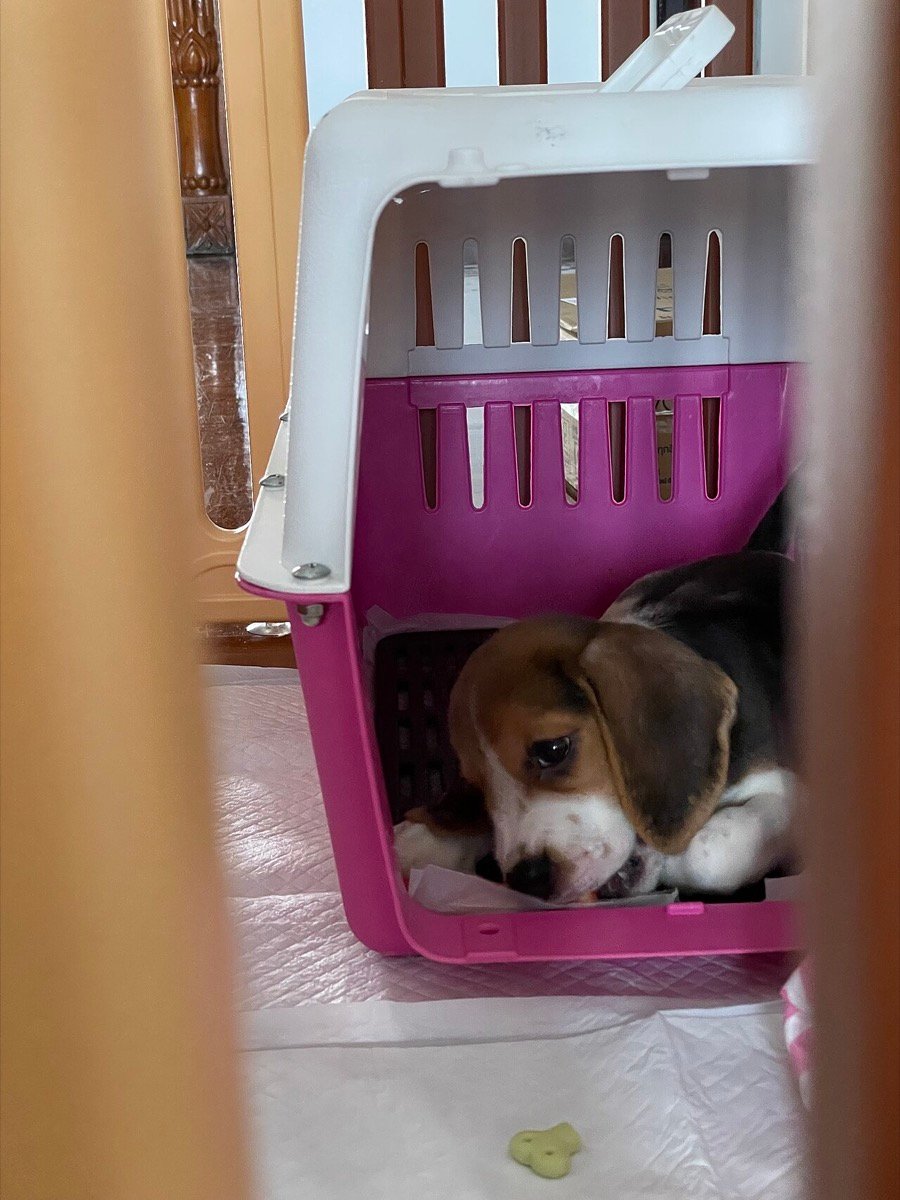

Plan crate time by age: about 30–60 minutes at 8–10 weeks, 1–3 hours at 11–14 weeks, and 3–4 hours at 15–16 weeks. Until 6 months, keep any single stretch to 3–4 hours. Trusted sources disagree on the upper end, so use the lower number and add potty breaks.
You've bought the crate. Your puppy goes in for a treat. Now the real question hits: how long can he actually stay in there, and what should the rest of the day look like?
Most guides give you one number and move on. The trouble is that four well-known sources give four different numbers for the same puppy. Below you'll see all four side by side, the number we'd plan around, and sample schedules for each age, for nights, and for owners who work.
- Crate limits grow with age, but no source says to crate a puppy under 6 months for more than about 4 hours at a time.
- Daytime limits are for awake hours. Nights work differently, and many puppies still need one trip out.
- Potty breaks drive the schedule: after waking, after meals, during play, and every 1–2 hours.
- An 8-hour workday needs a midday visit or a safe pen, not a longer crate stretch.
How Long Can a Puppy Stay in a Crate at Each Age?
Here is what four respected sources say, in their own terms. The last column is the number we'd plan around: the most cautious point where they overlap. It's our way of reading the sources, not a veterinary rule, and your vet can adjust it for your puppy.
| Age | ASPCA Pet Health table | "Months + 1" rule (Animal Humane Society) | Cap from Humane World / VCA | Plan around |
|---|---|---|---|---|
| 8–10 weeks (about 2 months) | 30–60 min (table starts at 9 weeks) | 3 hours | 3–4 h / 3 h | Up to 1 hour |
| 11–14 weeks (about 3 months) | 1–3 hours | 4 hours | 3–4 h / 3 h | 1–2 hours, 3 at most |
| 15–16 weeks (about 4 months) | 3–4 hours | 5 hours | 3–4 h / 3 h | 3 hours |
| 17 weeks to 6 months | 4–6 hours | 6–7 hours | 3–4 h / 3 h | 3–4 hours |
A few notes on where those numbers come from:
- ASPCA Pet Health gives the age table above as a rule of thumb and says to ask your vet for specific guidelines.
- The Animal Humane Society says to use your puppy's age in months plus one to work out the number of hours he can be crated.
- Humane World for Animals (formerly the Humane Society of the United States) says puppies under 6 months shouldn't stay in a crate for more than three or four hours at a time, because they can't control their bladders or bowels for that long.
- VCA's veterinary behaviorists say puppies left alone for very short periods, no more than 3 hours, can usually be confined in a crate. Past 3 hours, your puppy needs a potty break.
Why Do the Crate Time Rules Disagree?
Because they measure slightly different things. The "months plus one" rule is a bladder estimate. The ASPCA table is closer to how long a young puppy can comfortably rest in a crate. The caps from Humane World and VCA are about the longest single stretch a puppy should face alone.
Even one source can carry two numbers. Humane World's own crate training page gives the "three or four hours" cap in its main text and the "age in months plus one" guide in its FAQ. For a 5-month-old, that's either 4 hours or 6.
The safe reading is simple: treat every number as a ceiling, never a target. If your puppy has an accident or cries before the limit, his limit is shorter than the chart's. That's normal. Puppies vary.
Talk to your vet if… your puppy suddenly can't hold it as long as before, pees very often in small amounts, strains, or has blood in the urine. VCA notes that house soiling in a previously trained dog can have a medical cause. A schedule can't fix an infection.
What Breaks Does a Puppy Need During the Day?
The crate limit is only half the schedule. The other half is potty breaks, and VCA lists exactly when they're needed:
- Right after waking up from a nap.
- After a meal or a big drink of water.
- Every half hour during high-energy times, like running and playing.
- Every 1–2 hours while awake, on top of the times above.
- Every 4 hours, even if he has been resting.
- During the night, possibly until about 5 months of age.
Build the day around those moments and the crate stretches almost plan themselves. The schedules below are examples built from that list. Move the times to fit your home.
Sample Crate Training Schedule for an 8–10 Week Old Puppy
At this age, the crate is mostly for naps. Short stretches, lots of trips outside, and the door open whenever you're home and watching.
| Time | What happens |
|---|---|
| 6:30 | Wake up. Carry or walk him straight outside. |
| 6:45 | Breakfast in the crate, door open. Outside again after eating. |
| 7:00–7:45 | Play and a 2–3 minute training game. Outside every 30 minutes while he's busy. |
| 7:45–8:45 | Crate nap, about 1 hour. Put him in when he's already tired. |
| 8:45 | Wake up, outside. |
| 9:00–12:00 | Repeat the loop: awake time with you (about 45–60 min), outside, crate nap (up to 1 hour), outside. |
| 12:00 | Lunch in the crate, then outside. |
| 12:30–17:00 | Same loop. Short, calm crate practice while you're in the room counts too. |
| 17:00 | Dinner, then outside. |
| 17:30–21:30 | Evening loop. Keep the last hour calm. |
| 21:30–22:00 | Last trip outside, then into the crate for the night. |
| Night | Expect at least one quiet trip out. See the night section below. |
That rhythm of awake time, potty, nap and potty is the backbone of the whole first month. If your puppy just came home, our guide to the first day with a new puppy shows how to start it on day one.

Crate Training Schedule for a 3–4 Month Old Puppy
Between about 11 and 16 weeks, naps get longer and your puppy can handle short absences. The loop stays the same; the numbers stretch.
- Crate naps: 1–2 hours, moving toward 3 at the end of this stage.
- Awake time: about 1–2 hours, with a trip outside at least every 1–2 hours and after any wild play.
- Short absences: once your puppy can stay quietly in the crate for about 30 minutes with you mostly out of sight, the Animal Humane Society and Humane World say you can start leaving him crated for short periods.
- Practice while you're home: both groups say to keep crating him for short periods when you're home too, so the crate doesn't become a sign that you're leaving.
ASPCA Pet Health suggests teaching "wait" at the crate door so your puppy doesn't bolt out. That's an impulse-control skill, and it's the core of Brain Training for Dogs: short games that tire a puppy's brain before a nap. We reviewed it honestly, including who it isn't for.
Read our Brain Training for Dogs review → Independent review · we may earn a commission at no extra cost to you.Crate Training Schedule for a 5–6 Month Old Puppy
At this stage the crate starts to look like an adult dog's. Single stretches of 3–4 hours are fine for most puppies, and many sleep through the night. VCA's note is that overnight trips may be needed until about 5 months, so if yours still wakes you, he's not behind.
Two things change now:
- The door can stay open more. Humane World says that when you're home, the crate should have a comfy bed and an open door, so your dog can choose to rest there.
- Watch for longer days creeping in. ASPCA's table allows 4–6 hours from 17 weeks, but Humane World's cap is still 3–4 hours until 6 months. If you're regularly at the upper end, plan a break in the middle.
What Does a Puppy Crate Schedule Look Like at Night?
Night is not the same as daytime. A sleeping puppy is less likely to feel the urge to go, which VCA points out, so night stretches can run longer than the day chart. They still need planning.
- Keep the crate close. Humane World and the Animal Humane Society both suggest the bedroom or a nearby hallway at first, so you can hear him and he doesn't feel cut off.
- Last trip right before bed. No big drink just before crating.
- Expect one trip out at 8–12 weeks. Some owners set an alarm; others wait for the first whine. Either is fine.
- Make it a boring trip. ASPCA Pet Health says to stay low-key and skip play so he settles back into the crate easily. The Animal Humane Society calls it "a trip with a purpose, not play time."
- Move the crate later, slowly. Once he sleeps through the night near you, Humane World says you can gradually move it to where you'd like it.
Crying on the first nights is its own topic. We cover it in detail in crate training a puppy: the first week, day by day, including what to do if he panics. For the full night plan, from alarm potty trips to reading each cry, see crate training a puppy at night.
Crate Training Schedule for Working Owners
Here's the honest part. A 3-month-old puppy and an 8-hour workday don't fit inside a crate, by any of the four sources. So the plan has to add people or space.
- Add a person. ASPCA Pet Health suggests coming home at midday or hiring a dog walker. Humane World adds pet sitters and doggie daycare.
- Add space. The Animal Humane Society suggests a puppy-safe area, such as a small room, a gated section or an exercise pen. It holds the crate with its door removed, plus water, toys and a potty area. VCA describes the same set-up, with a resting spot and a pad or artificial turf.
A workday for a 3-month-old might look like this: out and breakfast at 7:00, crate at 7:45, a visitor lets him out and plays at 10:30, crate again, a second visit around 13:30, then the pen until you're home at 17:30. Fewer visits? Use the pen for the whole day instead of the crate.
There's a reason to take this seriously. The Animal Humane Society warns that a dog forced to soil the crate because he was crated too long will be much harder to housetrain. Our potty training guide covers the rest of that picture.
How Do You Build Up to Longer Crate Times?
A schedule only works if your puppy is comfortable in the crate in the first place. The Animal Humane Society and Humane World use nearly the same steps:
- Introduce it. Drop treats near the crate, then inside. Never force him in.
- Feed meals in it. Close the door while he eats, then open it as soon as he's done. Build up to about 10 minutes after the meal.
- Stretch it while you're home. Sit nearby for 5–10 minutes, then leave the room for a few minutes, then come back.
- Go to 30 minutes. Once he stays quiet for about 30 minutes with you mostly out of sight, start short absences and nights.
Humane World says crate training can take days or weeks, depending on the dog's age, temperament and past experiences. Don't go too fast.
How Do You Know the Schedule Is Moving Too Fast?
- Whining to get out. ASPCA Pet Health and the Animal Humane Society both say this usually means you increased the time too quickly. Go back a step.
- Accidents in the crate. The stretch was longer than he can hold. Shorten it, and check the crate isn't so big he can potty in one end and sleep in the other.
- Real distress. The Animal Humane Society says that if a dog is distressed and trying to force the crate open, let him out right away, because he can be injured. That's a sign to rebuild the positive association first.
If the distress is about being alone rather than about the crate, Humane World is clear that a crate won't solve separation anxiety. Our guide to separation anxiety in dogs explains the difference and what helps.
When Can a Puppy Stop Using the Crate?
Humane World says to crate your dog until he can be alone in the house without accidents or destructive habits. Then move him to a closed area like the kitchen before giving him the whole house. VCA's benchmark is that a puppy who has gone 8–12 weeks without mistakes is probably ready for more freedom.
Many dogs keep using the crate as a bed for life. That's a good outcome, not a failure to "graduate."
Most of a puppy's awake time is a chance to teach something. Brain Training for Dogs breaks that into short daily games, from settling to focus. We reviewed it honestly, including who it isn't for.
Read our Brain Training for Dogs review → Independent review · we may earn a commission at no extra cost to you.For the bigger picture of training at home, start with our guide to training your dog without a trainer.
Frequently asked questions
How long can a puppy stay in a crate by age?
ASPCA Pet Health's rule of thumb is 30 to 60 minutes at 9 to 10 weeks, 1 to 3 hours at 11 to 14 weeks, 3 to 4 hours at 15 to 16 weeks, and 4 to 6 hours from 17 weeks. Humane World for Animals says puppies under 6 months shouldn't stay in a crate for more than three or four hours at a time.
What is the age in months plus one rule?
The Animal Humane Society says to use your puppy's age in months plus one to work out how many hours he can be crated. A 2-month-old puppy would get about 3 hours. It is a rough guide, and other sources give lower numbers, so treat it as a ceiling, not a target.
What is a good crate training schedule for an 8-week-old puppy at night?
Put the crate in or near your bedroom, take the puppy out last thing before bed, and expect at least one quiet potty trip during the night. VCA notes that puppies may need overnight outings until they are about 5 months old. Keep night trips calm and short, with no play.
Can I crate my puppy while I work 8 hours?
Not in the crate alone. ASPCA Pet Health suggests a midday visit or a dog walker for long workdays. The Animal Humane Society and VCA suggest a safe pen or small room with a resting spot and a potty area for any absence longer than your puppy can hold it.
Should a puppy nap in the crate during the day?
Yes, short naps in the crate are a good way to build the habit. VCA says most puppies learn to go to sleep when they are put into their crates, and that sleeping puppies are less likely to feel the urge to eliminate. Take your puppy out as soon as he wakes up.
How long does it take to crate train a puppy?
The Animal Humane Society says crate training can take several days or several weeks, depending on the dog's age, temperament and past experiences. Humane World for Animals says the same and adds: don't go too fast.
When can my puppy stop using the crate?
Humane World for Animals says to crate your dog until he can be alone in the house without accidents or destructive habits, then move to a closed area like the kitchen before giving access to the whole house. VCA says a puppy who has gone 8 to 12 weeks without mistakes is probably ready for more freedom.
Sources
Every number and rule in this guide comes from these pages. Checked November 2026.
- ASPCA Pet Health Insurance. Heather M. How to Crate Train a Puppy. Published October 6, 2023. Accessed November 2026. aspcapetinsurance.com
- Animal Humane Society. Crate training your dog or puppy. Accessed November 2026. animalhumanesociety.org
- Humane World for Animals (formerly the Humane Society of the United States). How to crate train your dog or puppy. Accessed November 2026. humaneworld.org
- VCA Animal Hospitals. Lindell, E., VMD, DACVB; Feyrecilde, M., LVT, VTS (Behavior). House Training for Puppies and Dogs. Accessed November 2026. vcahospitals.com

Canine behavior writer & rescue foster
Megan has fostered more than 30 rescue dogs, many of them puppies who needed a routine from day one. She uses force-free methods and writes PawHonest to share the honest, hype-free advice she wishes she'd had sooner.
A note on trust: I'm an experienced foster and an informed owner, not a veterinarian. The crate times in this guide are general guidelines from the sources above; your vet can adjust them for your puppy's breed, size and health. PawHonest is reader-supported: we may earn a small commission on purchases through our links, at no extra cost to you, and only recommend what we'd use on our own dogs.